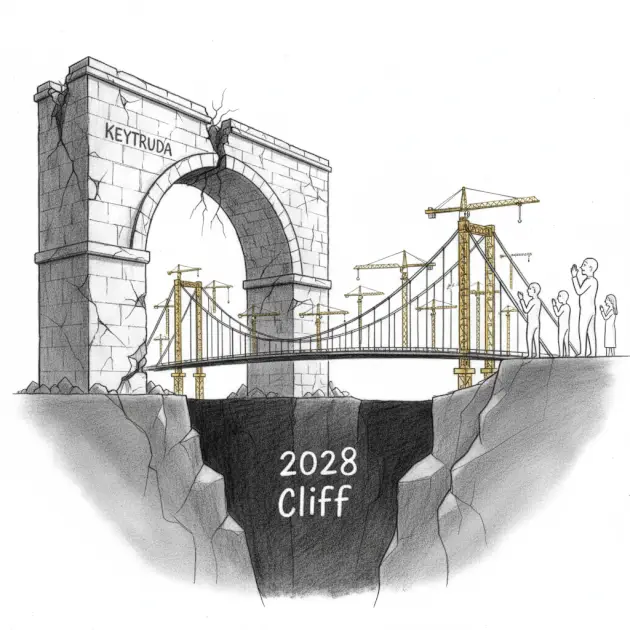
The Keytruda clock has been ticking for years. Everyone in pharma knows it. Keytruda generated tens of billions of dollars in annual revenue, and its core patents start expiring in 2028. That is not a rumor or a tail risk — it is a scheduled event. The question was never whether Merck would face that cliff. The question was always whether management would treat it like a deadline or a death sentence. The $6.7 billion acquisition of Terns, announced recently and landing on a market already watching Merck recover from a three-month low of $105.3, suggests they chose the former.
MRK closed at $118.9 on March 26, 2026. That is an 11% climb off the floor and still a few points below the 52-week high of $125.1. The stock is not euphoric. What it is doing, quietly, is pricing in a company that has figured out how to spend money without wasting it — and that distinction matters more than most investors currently acknowledge.
Start with the financials, because the draft narrative around Merck tends to skip them in favor of headline drama. Revenue grew from $64.2 billion in 2024 to $65.0 billion in 2025, per SEC filings. That is 1.3% growth — unimpressive on its own. But net income grew 6.6% in the same period, from $17.1 billion to $18.3 billion per the same filings. You do not get that kind of margin expansion on flat revenue unless you are cutting waste, renegotiating costs, or both. R&D spend as a percentage of revenue fell from 28.0% in 2024 to 24.3% in 2025 per SEC filings. The reflexive interpretation is that Merck is underinvesting in innovation. The more accurate one is that Merck is shifting from funding early-stage lottery tickets internally to acquiring late-stage, de-risked assets externally. Terns is exactly that kind of asset. You are not paying $6.7 billion for a hypothesis. You are paying for clinical data that already exists.
Capex-to-revenue moved the other direction, from 5.3% to 6.3% in 2025 per SEC filings. Physical infrastructure is being expanded even as internal discovery spending is rationalized. That combination — lower early-stage R&D, higher capital investment, and targeted external acquisitions — is a coherent strategy. It does not look like a company scrambling. It looks like one that made a decision.
The bull case does not rest entirely on Terns, and that is actually one of the underappreciated parts of this story. WINREVAIR, the pulmonary arterial hypertension drug Merck acquired with Prometheus, is building a revenue base outside the United States in ways that most coverage glosses over. This week, WINREVAIR received expanded formulary listings across multiple Canadian provinces. That does not move a stock in a day. But it establishes a non-US revenue floor for a product still in its launch phase, which matters enormously when domestic drug pricing reform is a live political risk. If US pricing compression arrives — and the probability of that is not zero — WINREVAIR’s international trajectory becomes a buffer that is not currently reflected in analyst models in any meaningful way. That is the silent variable in this bull case.
GARDASIL continues to generate long-term effectiveness data. The Quotient Therapeutics collaboration on inflammatory bowel disease points to diversification into high-growth therapeutic areas that are not purely oncology-dependent. Merck ended 2025 with $14.6 billion in cash and cash equivalents per SEC filings, which means the Terns deal does not require financial contortion. It is a check the company can write without compromising anything else on the roadmap.
Citi raised their price target to $125 following the acquisition announcement. That is a modest move from current levels, and I think it undersells what is actually being built here. Our view is that fair value sits closer to $140. The market is pricing Merck as a Keytruda-dependent company managing a graceful decline. That framing made sense two years ago. It makes less sense now, when the balance sheet is clean, the pipeline additions are concrete rather than speculative, and the international diversification is producing real formulary gains rather than press releases about intention.
The one number that deserves more scrutiny is revenue growth. A 1.3% increase year-over-year on $65 billion in sales is not expansion — it is maintenance. For the bull case to fully materialize, Merck needs Terns’ oncology assets to clear late-stage trials, WINREVAIR to scale internationally faster than current projections, and GARDASIL to sustain volume outside China where headwinds have been material. The weakest assumption here is that Terns’ late-stage assets will clear trials on timeline — clinical development has a way of punishing confidence. None of these outcomes are guaranteed. This is a probability distribution with a right-skewed tail that the current price does not fully capture.
What the market seems to be doing right now is watching the recovery from $105.3 and asking whether the bounce has legs or runs out of oxygen before $125. The bounce is real, it is grounded in actual financial performance and a coherent M&A strategy, and the resistance at the 52-week high is a technical friction point rather than a fundamental ceiling. The gap between $118.9 and $125 closes if one of the following happens: WINREVAIR posts a strong international quarter, a Terns asset hits a clinical milestone, or drug pricing reform turns out to be softer than feared. Any one of those is plausible in the next six to twelve months.
This is a similar setup to what we saw with Alphabet’s underpriced AI momentum — where the dominant narrative was so locked onto one risk that it stopped accounting for what was actually being built in parallel.
When a pharmaceutical giant spends $6.7 billion to solve a problem it caused by being too successful, that is not a warning sign — that is what a real business actually looks like.
Tags: Merck, MRK, Keytruda, Oncology, Terns Acquisition