Start with the price. On March 27, 2026, Alphabet closed at $281. The 52-week high was $350. That’s a 20% discount on a company that just quietly solved one of the hardest bottlenecks in commercial AI deployment — and most people covering the stock are still talking about ad revenue seasonality and Waymo burn rates like it’s 2023.
So let’s talk about TurboQuant, because the market is clearly not.
The Nasdaq is sitting at 21,408, down from a peak above 23,500. The whole tape looks wounded. That context matters because when indexes bleed this fast, everything gets sold together — the broken companies and the ones building structural moats get marked down in the same block. That’s not analysis. That’s just margin calls and momentum unwind. What it creates, occasionally, is a real opportunity. This might be one of them.
The core problem with scaling AI inference at commercial speed isn’t compute. Everyone focused on compute. Nvidia ate the decade because of that focus and it was largely correct. But the next constraint is memory bandwidth — specifically, how fast a model can pull weights from HBM and DRAM during live inference. As models get larger, this becomes the actual ceiling. You can stack as many GPUs as you want. If memory throughput is choking the pipeline, you’re bottlenecked regardless.
TurboQuant attacks this directly. By rethinking how large language models interact with memory at the architecture level — optimizing weight quantization in ways that reduce memory reads without degrading output quality — Google appears to have found a path to inference efficiency that external chipmakers can’t easily replicate. The silent variable in Alphabet’s current valuation is what this means for margins. If Google’s AI serving costs drop meaningfully relative to competitors still running on standard HBM configurations, that changes the entire competitive geometry of the Cloud AI market. Not in a distant theoretical way. In a next-four-quarters way.
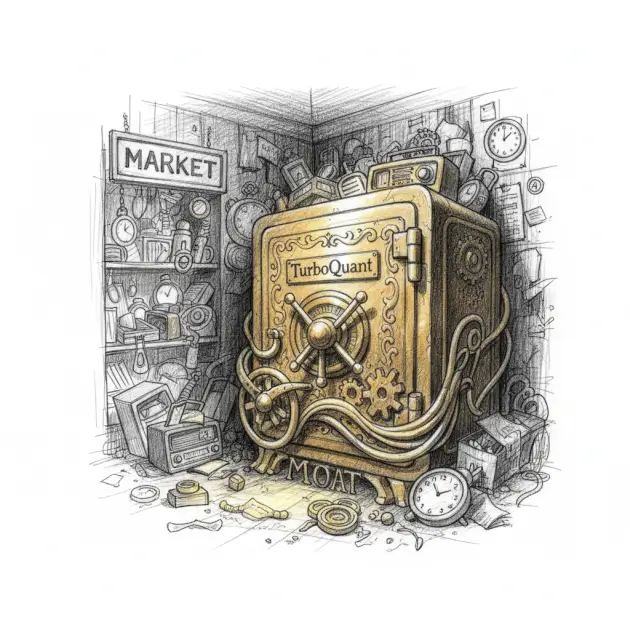
Cloud pricing wars are coming. Everyone who follows this space knows it. AWS, Azure, and Google Cloud are all racing to win enterprise AI contracts, and at some point price becomes a weapon. The conventional fear is that these wars compress margins across the board. That fear is priced into Alphabet right now. What isn’t priced in is the scenario where Google enters a price war with a structurally lower cost base than its competitors. That’s not a race to the bottom. That’s a moat. You can cut price, take share, and still expand margins. Amazon did exactly this in e-commerce for fifteen years and the market kept underestimating it.
The chart trajectory from January through March 2026 tells the short story clearly. Alphabet ran from $314 in January to $341 in February, then gave back the entire move and more, closing at $281 by late March. That’s not a fundamental deterioration. That’s a sector rotation and a macro fear trade. The underlying business hasn’t changed. The TurboQuant development hasn’t reversed. Waymo isn’t contracting. Cloud growth isn’t decelerating into anything alarming. The stock is cheaper because the index is cheaper, and the index is cheaper because sentiment is cheaper.
Waymo is the other piece people are misfiling. The narrative has been “expensive moonshot, unclear timeline, burning cash.” That was defensible in 2022. In 2026, Waymo is scaling service areas, converting R&D infrastructure into recurring revenue, and doing it with the kind of software-defined margin profile that makes it look less like a car company and more like a toll road. Autonomous ride-hailing, once it crosses the operational density threshold in a city, generates data that improves the model, which expands the service radius, which generates more data. The compounding is structural. It doesn’t need to be the biggest revenue line in Alphabet’s portfolio to be worth a meaningful multiple. It needs to stop being treated as a liability and start being treated as what it is — a high-margin utility layer that reduces Alphabet’s terminal dependence on search advertising.
Speaking of which: the regulatory risk that dominates bearish Alphabet coverage is mostly misfired at the wrong company. The litigation wave being discussed around social media addiction targets platforms built on engagement maximization for its own sake. Meta, TikTok, Snap — those are the architectures under pressure. Google Search and Google Cloud don’t operate on the same psychological manipulation model. Microsoft’s own infrastructure pivot signals that the serious players are moving toward utility and enterprise positioning, exactly where Alphabet already lives.
The historical R&D posture matters here too. For years, Alphabet has reinvested a massive percentage of its revenue into R&D. That wasn’t inefficiency. That was deliberate compounding. Custom TPUs, TurboQuant, Waymo, DeepMind — these are the outputs of sustained, unglamorous capital allocation into hard technical problems. The market tends to misprice these investments while they’re maturing and overcorrect once they’re obvious. We may be in the misprice phase right now, with the stock sitting 20% off highs while the infrastructure bets are starting to pay out.
None of this is guaranteed. The weakest assumption in this entire thesis is that TurboQuant’s inference efficiency gains translate cleanly from benchmark to production at scale — if deployment friction is worse than early indications suggest, the cost-advantage timeline stretches and the moat narrows before it matters. Waymo could hit regulatory friction in new markets. Cloud price compression could arrive faster than the efficiency moat matures. I’m not dismissing those risks. I’m saying they’re reflected in the current price, and the upside scenario — where TurboQuant delivers the margin structure it promises, Waymo crosses the density threshold in two or three more cities, and Cloud keeps compounding — is not reflected in the current price at all.
The market is charging you full price for the risk and giving you the upside for free. At $281, that’s the actual setup.
The whole system is designed to make you sell the thing that’s going to work right before it works — and buy back in at the top after everyone’s already written the congratulatory press release.
Tags: Alphabet, GOOG, TurboQuant, Waymo, Google Cloud