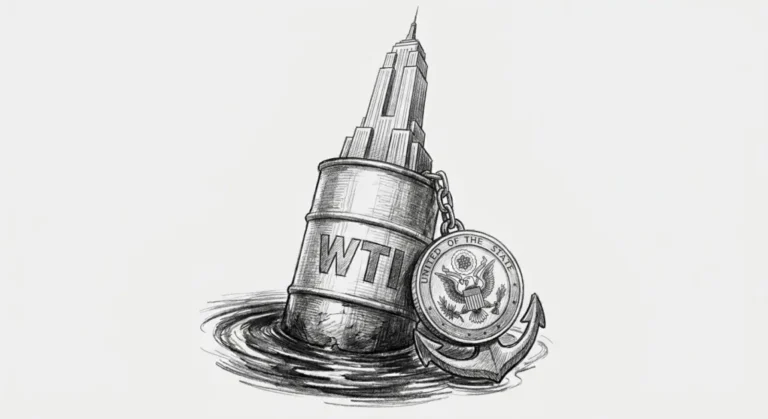
If WTI crude oil is trading closer to $90 per barrel over the next 2-3 quarters, what must be true today is that the current $84 per barrel level, recorded on April 16 and April 17, 2026, represents a temporary floor rather than the beginning of a structural downtrend. That scenario requires three conditions to hold simultaneously: the Strait of Hormuz transit normalization remains durable rather than episodic, the Federal Reserve’s rate posture stays predictable enough to keep discount rates from compressing energy-sector valuations further, and the Strategic Petroleum Reserve refill program continues to absorb supply at a pace sufficient to prevent inventory overhang from dragging spot prices lower.
Each condition is plausible. None is guaranteed.
The bull case for WTI is that the market is currently pricing the risk premium’s disappearance without adequately accounting for the structural demand floor that emerges when those same conditions persist. Last time we flagged Strait of Hormuz blockade duration as the central catalyst, that risk materialized sharply, driving WTI to $91.30 per barrel on April 14, 2026, before retreating to $89.70 on April 15 and then falling to $84.00 by April 16.
The four-day price arc itself is instructive. The market priced existential supply disruption in under 72 hours and then unwound nearly all of it in the same window. That speed of reversal is not evidence of a healthy, information-efficient market; it is evidence of a market trading sentiment rather than fundamentals, which means the underlying supply-demand picture has not actually changed as dramatically as the price move implies.
The single most important figure in this setup is the $7.30 per barrel drop between April 14 and April 17, a roughly 8% correction in four trading days. To decompose that move: if WTI at $91.30 embedded a geopolitical risk premium of approximately $7 to $9 per barrel above fundamental value, then the current $84.00 level implies the risk premium has been almost entirely stripped out. What remains is something close to a demand-and-inventory-based price.
The question worth asking is whether $84.00 is where crude belongs on fundamentals alone, or whether the market has overshot the removal of the premium and is now discounting a demand-softening scenario that the macro data does not yet support. The DXY index at 98.2, down from recent highs per the DXY index, offers a marginal answer: a softer dollar lowers the effective purchase cost for non-USD buyers, which at the margin sustains export demand and provides a technical support layer under the current price. That is not a large tailwind, but it is a genuine one.
Extending from that FX support layer, the interest rate environment adds complexity that tends to get underweighted in commodity analysis. The Federal Reserve has held rates at 3.6% for three consecutive months per Federal Reserve data, giving energy companies unusual clarity on their weighted average cost of capital, a variable that directly affects the discount rate applied to future production cash flows. When rates are moving, capex decisions in the energy sector become speculative; when rates are stable, operators can commit to drilling programs with more confidence, which over 2-3 quarters translates into production discipline rather than reactive over-drilling. The 2-year Treasury yield’s move from 3.5% in December 2025 to 3.7% in March 2026 per US Treasury/FRED data is a mild complication, but the magnitude is small enough that it does not structurally alter the investment calculus for producers operating above $75 per barrel breakeven costs.
The variable the market is most clearly underweighting is SPR refill velocity. The Strategic Petroleum Reserve was drawn down significantly as a policy tool, and the refill program, which involves the US government purchasing crude at prices it deems acceptable, creates a government-backstopped demand floor that operates independently of commercial inventory cycles. Because the pace of refilling is not consistently disclosed in real time, it introduces a price support mechanism that is structurally invisible to standard supply-demand models.
Over the next 2-3 quarters, if refill purchases are occurring at even moderate volumes, the effective demand picture for WTI is meaningfully stronger than the headline inventory data would suggest. Every barrel purchased for the SPR is a barrel not available for commercial inventory build, which prevents the inventory overhang scenario that would push prices decisively below $80. This thesis breaks if refill velocity has in fact slowed to a trickle that the opacity is concealing; that possibility cannot be ruled out.
The counter-scenario is straightforward. If transit normalization in the Strait of Hormuz proves durable, meaning tanker traffic flows freely for the next two to three quarters without renewed disruption, and if Chinese demand growth continues to disappoint relative to 2024 expectations, WTI could drift toward the low $80s without any single catalytic event. Shipping freight data already confirms reduced transit-related supply constraints as of April 2026, which removes one of the structural cost floors that had been supporting prices. In that environment, the DXY tailwind and SPR demand floor might not be sufficient to prevent a further 5-7% price compression.
That scenario is plausible over 12 months. It is less likely over the shorter 2-3 quarter window where rate stability and dollar softness are still operative. For downstream operators — refineries, logistics-heavy industrials, petrochemical producers — the current $84 per barrel level as of April 17, 2026 is unambiguously positive. Lower feedstock costs widen the cost-to-revenue spread directly, and if crude holds in the $82-86 range over the next 2-3 quarters, the margin tailwind for those sectors compounds quarter over quarter as fixed-cost structures absorb the relief.
Over the next 2-3 quarters, WTI crude sustaining above $82 per barrel is more likely than a demand-driven breakdown below $78, unless SPR refill activity slows materially while the Strait of Hormuz remains fully normalized, conditions that would need to occur simultaneously to overwhelm the current support structure. At $84.00 as of April 17, 2026, the price is consistent with a market that has correctly removed the acute risk premium but has not yet fully valued the structural demand floor beneath it.