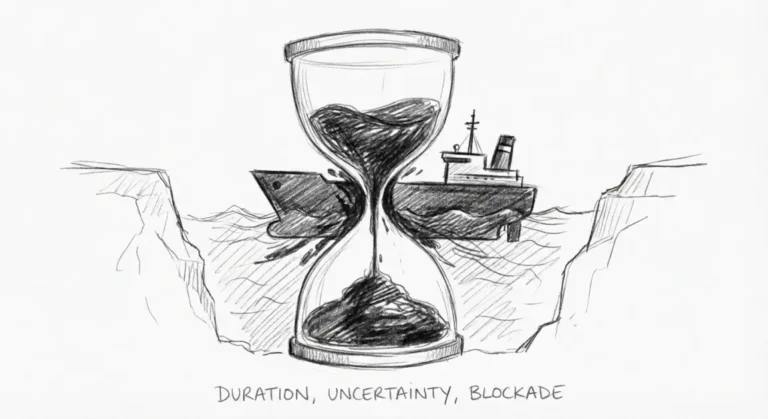
Traders are not afraid of $112. They are afraid of not knowing what comes after it. A specific, unresolved dread about the shape of the next six months is what is actually moving this market right now, not the spreadsheets.
Fear of unknown duration. Sit with that before reaching for the inventory models.
WTI crude landed at $112.1, up from $101.4 in mid-March. That $10.7 move in roughly four weeks is a physical scarcity trade. The distinction matters enormously for what happens next.
The Strait of Hormuz carries an estimated 20–21% of global oil transit according to EIA baseline figures. A blockade removes it from the reachable market entirely. Traditional inventory models were built for tightness, for marginal shortfalls, for OPEC+ cuts of 500,000 barrels here or there. Absolute cessation of a transit lane is a different animal.
The silent variable the market has not priced is duration. The blockade itself is already in the price. A credible probability distribution around how long the physical closure persists is not. Consensus energy models know how to price a two-week disruption. They know how to price a resolved crisis. Six months of genuine ambiguity breaks their architecture, and that uncertainty gap is where the next leg lives.
The Number That Actually Deserves Attention
The $10.7 move from $101.4 to $112.1 represents approximately 10.5% appreciation in one month. In isolation, dramatic. In context, it may be restrained.
Historical Hormuz disruption scenarios — even partial, even brief — have triggered 15–25% spot price reactions in prior cycles per IEA disruption analyses. A 10.5% move against complete regional transit cessation suggests the market either believes this resolves quickly or does not yet fully trust its own models.
Another 10% extension — call it an additional $11 — puts WTI near $123. Demand destruction mechanisms activate at that level in emerging market economies carrying dollar-denominated import bills. The feedback loop from price to demand to price becomes non-linear. That is a structural observation about where the next threshold sits.
The DXY at 100.0 adds a layer. A stable dollar keeps global purchasing power from deteriorating further, mildly constructive for crude. The dollar’s steadiness also signals something quieter: the broader macro has not panicked yet. Equity indices remain elevated. Credit spreads have not blown out. The energy market is an isolated stress zone rather than a systemic one. That isolation can end without warning.
What Breaks the Thesis
Diplomatic channels move faster than markets expect. A negotiated passage agreement — even partial — before June deflates the scarcity premium rapidly. WTI mean-reverts toward $90–95 with genuine velocity.
Supply-side workarounds gain traction. Saudi Arabia redirects flows through alternate routes. US SPR releases add meaningful buffer volume. Non-Hormuz producers accelerate output. Any combination of two of those three softens the physical scarcity argument materially. The weakest assumption in the bull case is that no combination of workarounds reaches meaningful scale within 90 days — history suggests improvisational logistics capacity gets underestimated.
The geopolitical risk premium is a bilateral bet. It requires both sustained physical disruption and the absence of an offsetting demand shock. A sharp slowdown in Chinese industrial activity removes the demand leg regardless of supply constraints.
The catalyst not yet in consensus pricing: the blockade persists past 90 days. At that duration, the market stops treating this as a spike event and starts treating it as a structural supply regime change. Energy capex decisions, refinery sourcing contracts, and sovereign reserve policies all reprice against a new baseline. That repricing is a slow, grinding multiple expansion across the entire energy complex. It happens mostly before anyone formally announces it.
Producer positioning reflects this asymmetry. Operators with exposure to non-Hormuz basin production — North Sea, Gulf of Mexico, West Africa — carry duration optionality the market has not fully valued. That is where the 6–12 month asymmetry sits, not in spot WTI itself.
The March jump deserves the most scrutiny. WTI moved from $65.4 to $101.4 — $36 in a single month. April’s move is a continuation. March was the discontinuity, the moment the market concluded this was not ordinary geopolitical noise. Everything since is the market arguing with itself about what “normal” looks like on the other side of a Hormuz closure.
There is a version of this story where $112 is the floor — duration compounds the scarcity, alternatives prove insufficient, and the energy complex enters a repricing cycle measured in quarters. There is also a version where diplomats move, ships move, and WTI sits at $88 by summer. The current price spike is already priced in; the risk of a structural supply regime change is not yet.
The oil market just reminded everyone that “energy transition” is a long-term policy preference, not a short-term supply substitute. Turns out solar panels don’t fit in a tanker.