25.2% upside to avg target
$135.00
Can Charles Schwab’s earnings model hold at current valuations if the yield spread keeps compressing? The stock is sitting at $92.62, nearly touching the consensus low target of $92.00, and the question isn’t whether competition from Robinhood is intensifying. It’s whether the structural mechanics of Schwab’s core profit engine are being correctly assessed by analysts who have rallied behind an average target of $116.85.
Start with the cash flow. FY2025 operating cash flow of $9.31B against $548M in capital expenditures produces free cash flow of $8.76B. That is not a distressed business. For a $162.3B market cap, that FCF yield sits at roughly 5.4%, not nothing, not spectacular, but in a rate-plateau environment, the question is what sustains that figure over the next 2-3 quarters. The answer is mostly net interest income, and net interest income is the variable that the consensus appears to be modeling with too much optimism.
The Federal Reserve has held rates at 3.64% since January. The 2-year Treasury yield climbed to 3.71% in March from 3.47% in February, per US Treasury data. That compression between policy rate and short-end yields is not incidental noise.
Spread compression.
SCHW’s Sweep Balance Problem and What the Consensus Misses
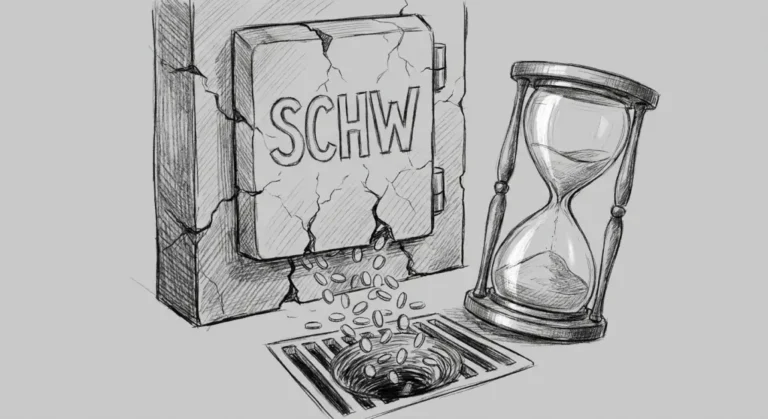
Schwab earns a meaningful portion of its net interest income by sweeping client uninvested cash into bank accounts and retaining the spread between what it pays clients and what it earns on short-duration assets. When short-end yields rise toward, or above, the Fed funds rate, that spread narrows. More directly: the incentive for Schwab’s higher-net-worth clients to leave cash in sweep accounts diminishes sharply. They move it to external money market funds yielding incrementally more. Unlike the analyst consensus, this analysis sees that dynamic as a slow-bleed structural drag, not a temporary rate-cycle footnote.
Decompose the NII exposure directly. Schwab’s total net revenues for FY2025 were $23.92B and net income was $8.42B. For a bank-adjacent business, operating margin calculated from gross interest income would overstate the profitability base; the relevant lens is the efficiency ratio and return on client assets. When sweep balances migrate out, they don’t just reduce NII; they reduce the low-cost funding base that allows Schwab to invest in slightly longer-duration assets for spread. If sweep outflows accelerate by even 10-15% over the next 2-3 quarters, the NII contribution shrinks at a rate that fee-based revenues, still in early growth phases, almost certainly cannot offset in the same window. Management commentary from the Q1 earnings call acknowledged digital platform reinvestment and client asset shifts, per the company’s earnings call. That phrasing does not read like confidence; it reads like management flagging exactly this migration risk without naming it directly.
Over the next 2-3 quarters, NII compression from continued sweep-balance migration is more likely to pressure earnings than fee-based crypto and digital initiatives can compensate, unless the 2-year Treasury yield reverses below 3.5% and widens the spread back in Schwab’s favor. That is the falsifiable claim, and it is not what the consensus is pricing.
Coverage desk hedging.
Morgan Stanley maintaining “Overweight” while lowering the target to $135 captures the tension in one action. The rating stays bullish; the target moves down. That is not conviction. That is a coverage desk reluctant to flip a major financial stock while preserving some analytical credibility by trimming the number. The average consensus target of $116.85 implies roughly 26% upside from $92.62. For that valuation to hold, what must be true? Either NII stabilizes, requiring the rate spread to re-widen, or fee-based and crypto-adjacent revenues accelerate materially within 2-3 quarters. Neither condition is clearly visible in the current data.
Robinhood is the competitor the market keeps invoking. The framing is fee compression, zero-commission trading, and younger-demographic capture. That framing is incomplete. Schwab’s actual vulnerability is not in commission-free equity trading; it abandoned that model years ago. The vulnerability is in cash management, specifically among clients who are sophisticated enough to notice a 25-basis-point gap between Schwab’s sweep rate and an external money market fund but not sophisticated enough to move their entire brokerage relationship. That is a large middle segment. Robinhood’s recent moves into retirement accounts and higher-yield cash products are exactly targeted at that cohort. Against this specific axis, Schwab’s scale advantage is less protective than the consensus model assumes. The thesis requires sweep stickiness to hold at a level the rate environment is actively undermining.
The counter-scenario deserves serious treatment. If the Fed cuts rates over the next two quarters, even modestly, the sweep economics reverse. Lower short-end yields reduce external alternatives’ attractiveness, client cash stays in Schwab’s ecosystem, and NII recovers. The $8.76B FY2025 FCF would look like a floor rather than a ceiling. At that point, the $116.85 consensus target starts looking plausible, and the current $92.62 price would represent a legitimate entry. The crypto expansion, with Bitcoin and Ethereum support described in management commentary, adds an optionality layer that is genuinely hard to value. If retail crypto volumes re-accelerate, Schwab’s integrated platform could capture a fee stream that pure-play brokerages cannot replicate at the same trust level.
But counting on rate cuts as the earnings stabilizer is not a margin-of-safety argument. It is a rate-direction bet dressed as a valuation thesis. SCHW has fallen from $105.08 in mid-February to $92.62 by mid-April, a drop of roughly 12% in two months, while the NII pressure thesis has only become more visible, not less. The stock is not pricing in a recovery. It is pricing in stasis. Whether stasis is fair value or a trap depends entirely on how quickly sweep balances stabilize and whether fee-based revenues can carry proportionally more weight in the earnings mix over the next 2-3 quarters, and that question is not yet answered by anything in the current data.
Can Schwab’s earnings model hold at $92 if the sweep spread doesn’t recover?