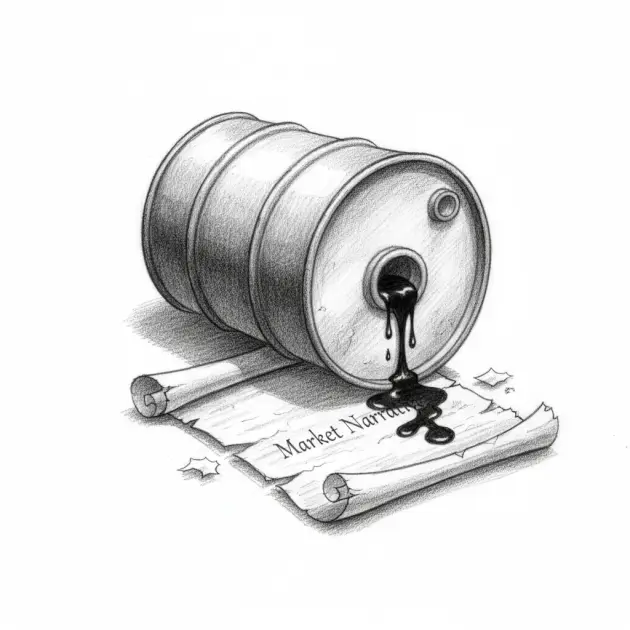
Start with what the price is actually saying. WTI Crude sat at $119.5 on March 9th. By March 23rd it had cratered to $88.1. It bounced — tepidly, almost apologetically — to $93.2 by March 26th. That’s not a correction. That’s a market that believed one story for months, got caught holding the bag, and is now quietly revising its memoirs. A 22% drawdown in under three weeks doesn’t happen because of one variable. It happens because several wrong assumptions were true at the same time, and then simultaneously weren’t.
The dollar is the easiest villain to point at. The DXY at 99.7 — knocking on the door of the psychologically loaded 100 handle — is doing exactly what a strengthening dollar always does to USD-denominated commodities: it makes them more expensive in every other currency, which shrinks the pool of real buyers, which drains the bid. This is the denominator-pressure mechanism. It’s boring, it’s mechanical, and it works every time. Portfolio managers running commodity-heavy books don’t wait for a clean signal when the DXY starts moving like this. They reduce exposure first and ask questions from a safer distance. That liquidation pressure doesn’t need a fundamental reason. It feeds on itself.
But the dollar story is the headline risk. The structural risk is quieter and considerably uglier. OECD commercial oil inventories have been building. This matters more than most of the commentary around WTI’s recent bounce would suggest, because inventory builds typically lag price action by four to six weeks. The price has already moved. The inventory data hasn’t fully shown up yet. When it does — when those storage numbers hit and confirm what the price decline has been hinting at — there’s no obvious floor. The market will have to reprice against actual oversupply rather than anticipated demand, and that’s a different animal entirely. The bounce from $88 to $93 looks fragile in this context. It looks like a market that stopped falling because sellers got tired, not because buyers arrived with conviction.
Copper is telling the same story with different words. The drop from $6.5 to $5.5 — a 15% decline — is the kind of move that would, in a healthier macro environment, get dismissed as noise or profit-taking. In this environment it reads as a referendum on the soft-landing thesis. Copper doesn’t lie about manufacturing. It doesn’t have a narrative. It just reflects what factories are ordering, what construction pipelines look like, what industrial throughput is doing across the major economic blocs. And right now it’s reflecting a cooling that the green-energy transition demand thesis was supposed to prevent. That thesis hasn’t been invalidated, exactly, but it’s been delayed. Delayed demand is not the same as demand. It doesn’t underwrite current prices.
The brief recovery in WTI from $88.1 to $93.2 deserves skepticism specifically because of how it happened. Low volume. No fundamental catalyst. No OPEC statement, no geopolitical escalation, no surprise draw in inventories. Just a reflexive bounce in a market that had moved fast enough to trigger some bottom-fishing. Dead cat bounces are real and they’re dangerous precisely because they look, for approximately 72 hours, like they might be something more. The $119.5 high from March 9th is now overhead resistance that functions almost as a ceiling. Getting back there would require a geopolitical shock of sufficient magnitude to overwhelm every current bearish signal simultaneously. That’s possible. It’s not a base case.
There’s a broader industrial vulnerability embedded in this setup that isn’t getting enough airtime. When the dollar strengthens and commodity prices fall in nominal terms, the instinct is to celebrate cheaper input costs. But the transmission mechanism matters. Countries importing these materials in weakening local currencies are not seeing cheaper inputs — they’re seeing more expensive ones, priced in dollars, paid in currencies that buy fewer dollars than they did six months ago. That dynamic suppresses consumption globally in a way that doesn’t show up cleanly in any single data series but accumulates across dozens of economies simultaneously. It’s diffuse, it’s hard to model, and it’s real.
The memory sector’s recent pain from AI-driven demand uncertainty offers a useful parallel here. In both cases, a macro narrative — AI-driven demand, commodity supercycle — ran well ahead of actual fundamental delivery. When the data stopped cooperating, the correction wasn’t gradual. It was abrupt, because the positioning had been built on a story, not on earnings or barrels or tons. Unwind a narrative and you unwind fast.
The question investors keep asking is whether this is a dip to buy or the opening act of a longer cyclical downturn. It’s a reasonable question with an uncomfortable answer. The dip-buying case requires believing that the inventory build is temporary, the dollar rally stalls, industrial demand in China and Europe stabilizes, and that weakness in copper is a timing issue, not a signal. The weakest of those assumptions — that China’s industrial demand stabilizes near term — has the least supporting evidence and the most wishful thinking behind it. All of those conditions need to be true at once. The cyclical downturn case, by contrast, requires only that current trends continue. One scenario needs everything to go right; the other needs nothing in particular to go wrong. To be fair, a sudden OPEC production cut or a Middle East supply disruption could re-establish a floor faster than any inventory report, and writing off that possibility entirely would be its own form of narrative trading.
The commodity supercycle had a great story. Scarcity, green transition, underinvestment in production, deglobalization pressures on supply chains. Some of that is still structurally true over a multi-year horizon. But markets don’t pay you for being right on the right timeline. They pay you for being right now. And right now, the weight of evidence isn’t pointing at scarcity. It’s pointing at a market that priced tomorrow’s supply constraints into today’s spot price, and is now discovering that tomorrow is further away than advertised.
The real crime isn’t that oil fell 22%. It’s that everyone acted surprised, as if the price at the top had any relationship to what the world was actually consuming.
Tags: WTI Crude, Commodity Markets, US Dollar Index, Oil Demand Destruction, Industrial Slowdown