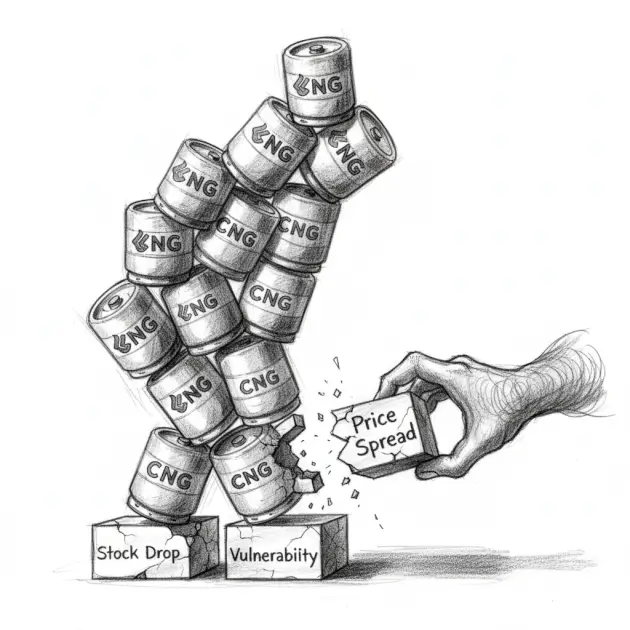
Maruti Suzuki has shed 25.4% in under three months — from a quarterly high of ₹16,703 to ₹12,452 as of March 24, 2026 — and the surface-level explanation, crude oil and a weak rupee, only tells half the story. The other half is sitting in a number almost nobody in the Indian auto conversation is talking about: the CNG-to-petrol price spread.
Start with the oil shock. WTI crude hit $91.2 per barrel in late March 2026, up from $71.2 just one month earlier — a 28.1% surge in thirty days. That kind of move doesn’t happen in a vacuum. The driver is geopolitical: U.S.-Israel strikes killed Iran’s Supreme Leader Khamenei in early March 2026, setting off a full-scale energy shock across the Middle East. Bloomberg is reporting that Iran’s attacks wiped out 17% of Qatar’s LNG capacity for up to five years. Reuters confirmed Iraq declared force majeure on foreign-operated oilfields over Strait of Hormuz disruption. This isn’t a blip. The war risk premium that nobody was pricing correctly is now front and center — and it’s showing up directly in Maruti’s cost structure and demand outlook.
Here’s the thing: for most Indian automakers, a crude spike is a headache. For Maruti specifically, it’s a compound problem. The rupee is now trading at 93.5 against the dollar as of March 24, 2026 — deep in historically stressed territory — which inflates royalty payments to parent Suzuki Motor Corporation in Japan. Every yen-denominated payment just got more expensive in rupee terms, and Maruti has limited contractual flexibility to renegotiate those obligations in the short run. The company has spent years expanding domestic localization precisely to reduce this exposure, but at 93.5, that cushion is getting worn thin. This is a structural cost problem, not a temporary accounting quirk.
The NIFTY 50 is down 12.4% from its quarterly peak of 26,142, so there’s clearly a broad risk-off wave dragging everything lower. But here’s what nobody’s saying: Maruti is underperforming even within that selloff. A stock that drops twice the rate of its benchmark index in a quarter isn’t just experiencing macro drag — it’s repricing company-specific risk. The market is telling you something about Maruti beyond general pessimism.
That something is CNG. Maruti holds more than 70% market share in India’s CNG passenger vehicle segment — a position it spent years building as CNG offered consumers meaningfully lower total cost of ownership versus petrol. The entire value proposition rests on a single variable: the spread between CNG prices and petrol prices staying wide enough to justify the upfront premium. Now squeeze global LNG supply — Qatar’s capacity hit, Hormuz disruptions, European LNG scramble all happening simultaneously — and domestic gas prices in India face serious upward pressure. If CNG prices in India get revised upward meaningfully over the next two quarters, Maruti’s highest-growth segment loses its core selling point. The company’s biggest strategic bet is also its biggest latent vulnerability.
This is what makes the current setup genuinely structural, not just cyclical. A cyclical oil spike hits margins and cools demand temporarily. A structural repricing of CNG’s cost advantage rewrites the competitive logic of the segment entirely. If the spread compresses from, say, ₹40-45 per km in savings to ₹20-25, a meaningful chunk of marginal CNG buyers simply don’t bother — they stick with petrol or wait. That hits Maruti’s volume growth story at exactly the moment the broader market is already pricing in a slowdown.
I’ll be blunt: the stock at ₹12,452 is closer to its 52-week low of ₹11,059.5 than its high of ₹17,370. The market has done significant repricing already. But the CNG spread dynamic isn’t yet in the mainstream analyst narrative for this name — most conversations are still anchored on input cost margins and INR/USD mechanics. That’s a lag. If the government announces domestic gas price revisions in the April-June policy window, which is historically when LNG contract benchmarks reset, the next leg down could surprise people who think the 25% correction already reflects everything. That said, it’s worth noting the most vulnerable assumption here: if India’s administered gas pricing regime absorbs the global shock through subsidies rather than passing it through, the CNG spread compression may never materialize at the consumer level.
Still — and this matters for anyone eyeing the wreckage as a buying opportunity — a 25% drawdown on a stock with 70% segment dominance in India’s fastest-growing fuel category does create a setup where even modest stabilization produces a sharp rerating. Maruti’s balance sheet remains fortress-grade, with net cash exceeding ₹45,000 crore as of December 2025. The domestic auto cycle hasn’t broken; it’s been interrupted. If CNG economics hold, the volume story reasserts itself fast, and the current price embeds an unusually pessimistic scenario for a company that has navigated every previous oil shock without losing structural market share.
The single variable that flips all of this: a rapid Hormuz stabilization and cease-fire that reverses the LNG supply shock. If global gas prices normalize to pre-war levels within sixty days, the CNG spread holds, the rupee recovers some ground, and Maruti’s selloff looks like an overreaction. Watch this space — but don’t hold your breath. Bloomberg’s coverage of the Iran war suggests this is being priced as a multi-quarter disruption, not a two-week crisis.
Maruti’s correction is partly macro, partly sector, and partly a very specific structural risk embedded in its flagship growth strategy that hasn’t fully hit the headlines yet. The oil-rupee combination is real. The CNG vulnerability is the part the market is still slowly discovering.
It’s funny, isn’t it — we build entire industries around the idea that something is cheaper and cleaner, and then one war on the other side of the planet blows up the economics. Nobody promised you the cheaper option would stay cheaper forever, but we sure did sell it like it would.
Tags: Maruti Suzuki, NIFTY 50, Crude Oil, CNG prices, Indian auto sector