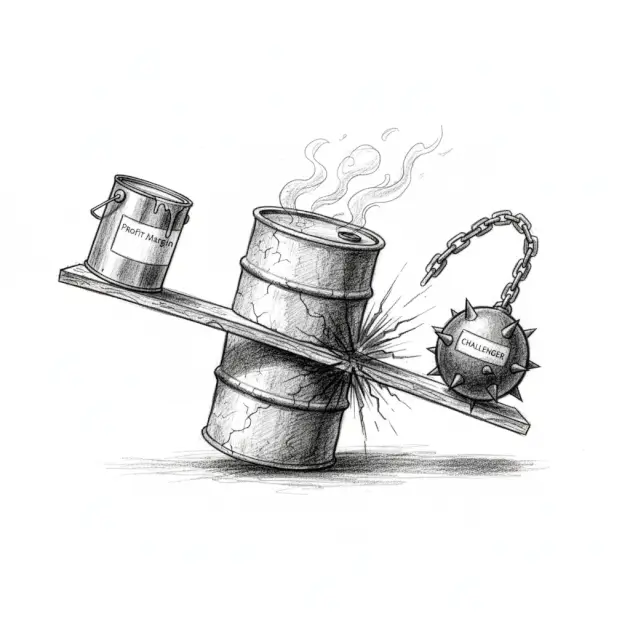
Asian Paints closed at ₹2,220.1 on March 24, 2026 — a 4% bounce off a five-year low, on the same day WTI crude settled at $90.6 per barrel, down from a war-induced spike above $100 just ten days prior. That’s the primary signal here: a geopolitically driven cost input that spiked, peaked, and is now reversing — and a stock market only beginning to reprice the relief. The crude-to-margin transmission mechanism for Asian Paints runs faster than most investors assume, and that lag is the investable gap.
Here’s the thing about India and the Iran conflict: Bloomberg noted on March 16 that Modi was walking a precise diplomatic tightrope between Washington and Tehran. India imports roughly 85% of its crude, and Iran was historically a discounted source before sanctions tightened. The US military strike on Iranian power infrastructure briefly sent WTI past $119/bbl at the 52-week high, and that pain flowed directly into Asian Paints’ raw material basket. Petrochemical derivatives — monomers, phthalic anhydride, titanium dioxide precursors — collectively account for 30–35% of the company’s cost of sales. When oil goes from $90 to $119, that’s a margin hit of 5–7 percentage points in a business already operating near cyclical lows. When it reverses to $90 on geopolitical de-escalation, the cost structure doesn’t snap back in a single day — but the market does tend to react as if it will. That pricing gap created Tuesday’s move.
The stock peaked at ₹2,985.7 within the last 52 weeks and now sits 25% below that high. From ₹2,785 in January to ₹2,402 in February to ₹2,220 in March — a cascading re-rating driven almost entirely by two forces: crude-cost pressure and the structural de-rating of premium consumer franchises in India as earnings visibility collapsed. The 4% single-session bounce doesn’t reverse a three-month downtrend on its own. But it is consistent with a textbook margin-bottom pattern, where inputs peak, the stock pre-discounts the worst, and then begins recovering before actual earnings improvement shows up in a P&L.
What makes the setup more interesting is the price hike decision. Asian Paints implementing increases across its decorative portfolio right now is a deliberate signal to institutional investors: we believe demand elasticity is low enough to hold pricing. That’s a confidence call. It is also being made at exactly the moment when crude is softening, which means if the hikes hold, you get a double tailwind — price realization goes up while input costs go down. The arithmetic on gross margin recovery is significant. Even a 2–3 percentage point margin improvement on a ₹30,000+ crore revenue base translates to roughly ₹600–900 crore of incremental EBIT, which on current depressed multiples gets you material upside to fair value.
The sector read-through confirms the positioning: Berger Paints gained nearly 5% on the same session, which is wild for what should have been a company-specific event. The market isn’t just pricing in one company’s decision — it’s declaring a sector-wide margin floor. That’s important because Berger and Kansai Nerolac have similar crude sensitivity profiles, and all three have been dragged down together through the oil shock cycle.
The USD/INR rate at ₹93.5 as of March 24 adds a real wrinkle that the bullish narrative smooths over too quickly. India imports chemicals beyond just crude oil derivatives — dispersants, specialty pigments, certain monomers — all dollar-denominated. A rupee at ₹93.5 per dollar partially offsets any benefit from crude cooling in USD terms. It’s not a thesis-killer, but it means gross margin recovery is unlikely to be as clean or as fast as Tuesday’s price action suggests. Partial offset, not full offset — but it matters for sizing the recovery precisely.
Let’s be real about the flip variable: if Birla Opus — Aditya Birla Group’s aggressive new entrant — forces Asian Paints to choose between holding price hikes and defending market share, the entire bull case collapses. Birla Opus has entered with a deliberate penetration pricing strategy, capacity built for aggression, and a balance sheet that doesn’t need to recover margins this quarter. If Asian Paints’ announced hikes don’t hold because volumes start bleeding to the challenger, then rising crude input costs hitting the income statement simultaneously with volume loss is the worst-case combination. That scenario alone is what keeps the stock 25% below its highs even when oil is at $90 rather than $119. The market isn’t ignoring the crude tailwind — it’s discounting it against the Birla Opus structural risk. The question is whether that discount is too aggressive.
This is a cyclical call, not a structural one. The thesis is: crude de-escalation plus price hike announcement equals a margin bottom forming. The most vulnerable assumption is that Asian Paints can hold these hikes against a well-capitalized challenger that has every incentive to undercut them. The thesis breaks if Birla Opus forces a price rollback and crude re-escalates toward $100 — a scenario that remains plausible so long as the Iran situation stays unresolved. Bloomberg as of March 24 is still describing Europe grappling with an Iranian energy price shock. A single White House communications change on strike timing could reverse the $90 crude reading within a week. That’s the fragility embedded in Tuesday’s move. Watch this space.
Every airline has a frequent flyer program. Every hospital has a gift shop. Every paint company has a “we believe in pricing power” press release right before they quietly start discounting to keep shelves full. Same story, different palette.
Tags: Asian Paints, Crude Oil, Indian Markets, Margin Recovery, Birla Opus