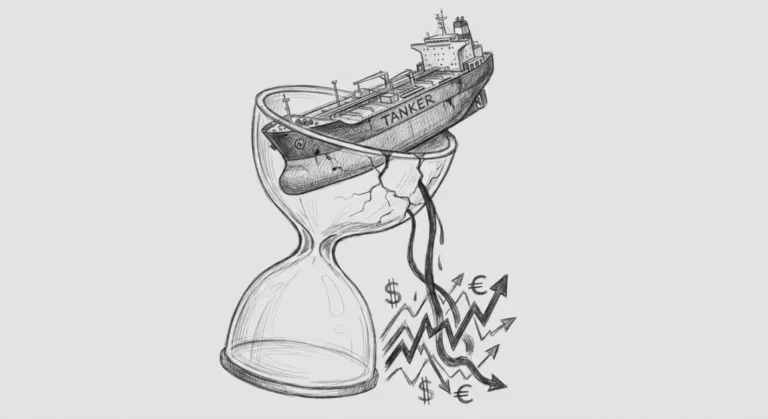
Three months ago, WTI crude sat at $55.0 a barrel — cheap enough that energy desks were trimming positions and rotation into tech felt like the obvious trade. Today it prints at $112.1, and Brent spot has climbed to $141.0, a level not touched since 2008. That’s not drift. That’s a market that got repriced at the root.
The Strait of Hormuz closure did what every geopolitical risk event promises to do and almost never does: it bit, hard, and held. Tanker rates jumped to multi-decade highs. Persian Gulf barrels that normally flow east toward India and Japan and west toward Europe got stuck. The physical market tightened before the futures market caught up — and that sequencing is how supply shocks work, not the paper shocks that fade in a week.
What the Chart Actually Says
January: $58.3. February: $65.4. March: $94.5. April: $112.1. Each monthly step is bigger than the last — not a spike but an acceleration. That shape matters. A spike suggests a single event. An acceleration suggests the market keeps finding new reasons to buy, or keeps finding fewer reasons to sell. Both apply here. Each week that the Strait stays closed, another wave of buyers gets forced in — refiners covering forward needs, traders squeezing shorts, sovereign buyers stocking reserves. The bid has layers.
Pick the number that anchors all of this: $94.5, the March print. That was already a shock level — a 62% climb from the January low in sixty days. But March was still pricing in a Strait disruption the market assumed would resolve. It didn’t. The jump from $94.5 to $112.1 in April is the market revising that assumption. A 10% move higher puts WTI near $123, placing the 2022 spike highs around $130 back in the conversation. A 10% pullback lands near $101 and holds above the psychological $100 floor only if the Strait situation stays unresolved. The direction of that one number tells you almost everything about where energy equities, inflation swaps, and central bank language go next.
India’s signal is worth pausing on. Import-dependent economies don’t usually flag supply chain strain loudly — they absorb it quietly through subsidy, currency adjustment, or demand destruction. When they speak, the pain is already embedded. India’s public acknowledgment of supply chain stress means the physical market, not just the futures curve, is stressed. Different beast entirely.
The Shadow Inventory Problem
Tankers are sitting full in the Gulf, loaded with crude that cannot move through the Strait. This shadow inventory — cargo stranded mid-route — creates artificial scarcity in the short run and a latent supply overhang in the medium run. The bull case lives comfortably in the short run. If the Strait stays closed, those barrels don’t reach the market, prices hold or climb, and the supply tightness is undeniable. But this is also the variable that could snap the trade. A sudden reopening doesn’t just restore normal flow — it dumps deferred supply onto a market that priced it as absent. The unwind could be fast and ugly.
Here’s what breaks the bull case cleanly: a ceasefire holds, the Strait reopens, shadow inventory floods the spot market, and global demand — already softer given where the S&P 500 sits at 6,582.7, down from its recent peak — fails to absorb the surge. Add a coordinated SPR release from the U.S. and IEA members, both of whom have historical precedent for executing quickly, and you get a $20-30 unwind in weeks. That scenario is not dominant. It’s not a tail risk either.
The binary sitting over Iranian energy infrastructure makes this harder. Military action against those sites removes barrels permanently — not deferred, gone. That’s the scenario where $141 Brent looks like a waypoint rather than a ceiling. A tactical resolution through negotiations, partial Strait access, or a face-saving exit is where the overhang risk concentrates. The market right now is pricing something between those two poles. It’s wrong about at least one of them.
Energy-exposed equities haven’t fully caught up to the crude move. Equity investors are discounting demand destruction — they look at $112 WTI and worry about margin compression across industrials, transport, and consumer names. They’re not wrong to worry. But they may be too focused on the demand side and not focused enough on the supply side’s staying power. The Strait doesn’t reopen on a schedule. Iranian infrastructure doesn’t rebuild in a quarter. Physical tightness has a longer half-life than equity investors typically price in during a geopolitical event. The weakest assumption in the bull case is that diplomatic channels remain frozen — any serious negotiation could deflate the premium in days.
Brent at $141 last appeared during the 2008 financial crisis, when demand destruction eventually overwhelmed the supply thesis and crude collapsed from $147 to $35 in six months. Worth holding that history. But the 2008 move was demand-led on the way up — Chinese growth, dollar weakness — and demand-destroyed on the way down through global recession. This move is supply-constrained on the way up. The mechanism of reversal, if it comes, is different. A Strait reopening is faster than a global recession. The risk is sharper, not slower.
The S&P 500 at 6,582.7 is absorbing this uncomfortably but not breaking. Energy’s weight in the index means the sector is partially offsetting losses elsewhere. For now. If crude holds above $100 through the summer, the inflation conversation reopens in a way central banks spent two years trying to close. Rate expectations shift. Equity multiples compress. The energy bull case and the broad equity bull case stop moving together — they start trading against each other.
That’s the setup. The supply shock is undeniable, the shadow inventory risk is present, and the binary on Iranian infrastructure hangs over everything. The bull case on crude isn’t that everything goes right — it’s that the supply disruption outlasts the market’s patience for pricing it. So far, it has. The supply constraint is structural, not cyclical. The market is pricing in a transit disruption but is not yet pricing in a permanent degradation of Middle East production capacity.
The oil industry spent thirty years telling us they were essential infrastructure and not a political football. Turns out they were right about one of those things.