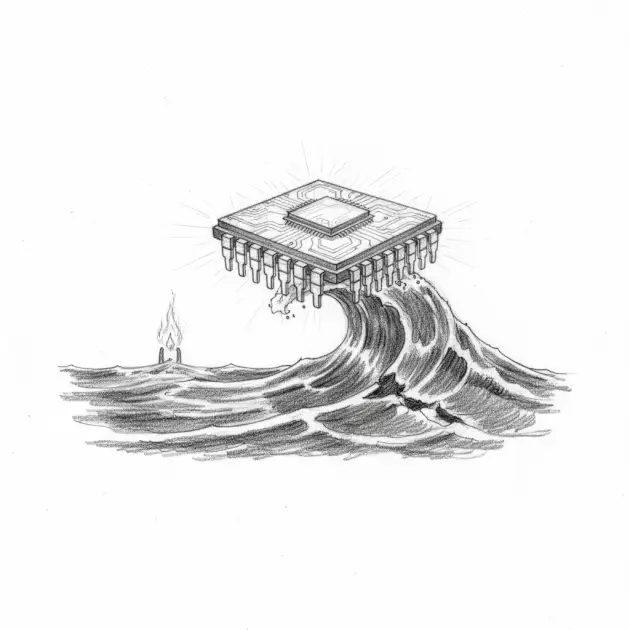
What is the market actually pricing when it looks at Nvidia right now — the Rubin cycle, or the risk that the infrastructure beneath it cracks before the product ships?
As of late March 2026, Nvidia closed at $168, down 21% from its three-month high of $212. The Nasdaq Composite is sitting at 20,948, off more than 2,600 points from its February peak. WTI Crude settled at $100, a near-doubling from its three-month low of $56. And for the first time in 13 years, Nvidia is trading at a forward P/E discount to the broader S&P 500. That last number is the one worth sitting with. A company that has defined the AI investment thesis for three years is now cheaper, on a forward earnings basis, than the average stock in the index it used to pull higher. That’s not a routine correction. The market is reconsidering what it thought it knew.
The bearish read is straightforward: regulatory drag, China exposure, and macro volatility. The “Chip Security Bill” is moving through the House with bipartisan support, following federal charges against Super Micro’s co-founder. If it passes with its current export control language, it likely puts a permanent ceiling on Nvidia’s addressable market in China — a market where ByteDance and Alibaba are already pivoting toward Huawei’s 950PR chip. That’s not a future risk. It’s an ongoing erosion being legislated into permanence. Add an 800-point Dow drop, crude oil at $100, and geopolitical noise radiating out of the Middle East, and the market’s current hesitation looks rational.
But the catalyst the market hasn’t fully priced isn’t the Chip Security Bill. It’s Taiwan’s energy supply.
The Quiet Variable Nobody Is Running
The Strait of Hormuz is getting most of the attention right now, and reasonably so — crude at $100 has a way of focusing minds. What isn’t getting equivalent attention is that Taiwan runs on imported liquefied natural gas, not partially but critically. TSMC’s fabrication facilities are among the most energy-intensive industrial operations on the planet. Chip fabrication at the leading edge — the kind Nvidia’s Rubin GPU architecture demands — does not tolerate power interruptions, even brief ones. The process tolerances are that tight.
If the Iran-Israel conflict extends in a way that disrupts LNG tanker routes — which it doesn’t need to do dramatically, just enough to tighten the spot market and push prices — Taiwan’s energy cost structure changes materially. TSMC’s operational costs rise. Lead times extend. And suddenly the Rubin supply chain, which Micron has been shoring up with HBM4 memory production specifically targeting Nvidia’s 2026 deployments, hits a constraint that no amount of export control lobbying or trade policy can fix. You can’t legislate around a power grid.
This is the asymmetric risk the market is not running in its models. Export bans get written into analyst notes within 48 hours of a congressional hearing. Energy supply shocks to a Pacific island that fabricates roughly 90% of the world’s most advanced chips, per industry estimates, get filed under geopolitical background noise. They shouldn’t be. A sustained spike in Taiwan’s LNG import costs over two quarters would show up in TSMC’s guidance — and TSMC’s guidance would show up in Nvidia’s margin assumptions faster than any trade restriction.
What the Rubin Cycle Actually Represents
None of this changes what Nvidia is building. The Vera CPU and Rubin GPU architectures represent the clearest product roadmap the company has had in years. The $1 trillion data center outlook, per management’s own framing, isn’t marketing — it’s backed by hyperscaler commitments that have been building for 18 months. Micron’s HBM4 mass production announcement this week was not a minor supply chain update; it was a signal that the hardware stack for 2026 deployments is locking in. The fundamental case for Nvidia is, by most honest measures, stronger now than it was when the stock was trading at $212.
And yet here it sits at $168, at a forward P/E discount to the S&P 500. That gap between fundamental strength and current price is exactly where catalysts tend to live. The question is which catalyst arrives first — the one that closes the gap, or the one that widens it.
The Chip Security Bill matters, but its China impact is already partially absorbed. ByteDance and Alibaba were pivoting to Huawei before the bill had a hearing. The market priced some version of that two quarters ago. What isn’t priced is a scenario where TSMC operational continuity becomes a live question because of energy supply dynamics that have nothing to do with semiconductors and everything to do with a conflict 4,000 miles from Hsinchu. The weakest assumption in this thesis is that LNG route disruptions would be severe or sustained enough to actually alter TSMC’s fab scheduling — historically, spot market spikes in energy have been absorbed without visible production impact.
If that scenario doesn’t materialize, Nvidia at $168 trading at a discount to the index looks like a setup. The Rubin cycle ships, data center capex continues at pace, and the valuation anomaly corrects. That’s the base case and it’s not a weak one.
If it does materialize — even a softer version where LNG spot prices spike for one quarter and TSMC quietly adjusts its fab scheduling — then the current price isn’t a floor. It’s a pause.
The honest read is that the market has priced the regulatory ceiling reasonably well and hasn’t priced the energy floor at all. That asymmetry is the story for the next six to twelve months. Not whether Nvidia’s chips are good — they are — but whether the infrastructure required to make them stays intact in an energy environment that is no longer predictable.
Watch the LNG spot market. Watch Taiwan Power Company’s import data. Watch TSMC’s quarterly guidance language around operational costs. These are not the numbers anyone has on their Nvidia watchlist. They probably should be.
We built the most powerful artificial intelligence infrastructure in human history, and its single biggest vulnerability is that we need to boil water near a geopolitical fault line to run it.
Tags: Nvidia, Vera Rubin GPU, TSMC Energy Risk, Chip Security Bill, AI Supply Chain