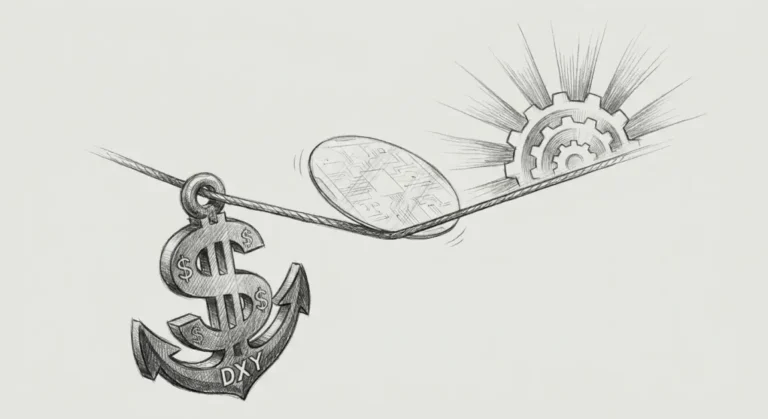
If UMC’s operating margins are measurably wider twelve months from now than they are entering the April 29, 2026 earnings release, the pathway to that outcome is already partially visible in today’s macro configuration, and the market has not fully credited it. A softening dollar, with the DXY index sitting at 98.2 as of April 18, 2026 after briefly touching 99.7 in mid-March, relieves one of the more persistent structural headwinds that export-oriented foundries absorb quietly into their unit economics. The question is whether UMC’s cost structure and utilization trajectory can convert that macro tailwind into durable operating income expansion over the next twelve months.
That conversion depends on a set of conditions present in outline but not yet confirmed in data. UMC prices a meaningful share of its foundry services in US dollars while carrying a cost base denominated partly in New Taiwan dollars, a configuration that causes dollar weakness to compress revenue translated back to local currency while also providing some relief on imported material costs. The net effect of a DXY move from 99.7 to 98.2 is not catastrophic in either direction, but the directionality matters: a dollar index trending toward the lower end of its recent range, rather than recovering toward prior highs, is structurally constructive for the margin arithmetic of a foundry with UMC’s geographic and currency profile. If the DXY continues drifting rather than reversing, the tailwind compounds across each subsequent quarter’s revenue recognition.
What April 29 Must Confirm
The 1Q 2026 earnings release and investor conference call, scheduled for April 29, 2026 per UMC’s investor relations calendar, is the first hard data point that either validates or undermines the twelve-month scenario. For the bull case to hold, the call needs to do two things simultaneously: demonstrate that utilization rates have stabilized or improved relative to the prior quarter, and provide forward guidance language that does not retreat from management’s previously stated capacity commitments. One without the other is insufficient.
A utilization uptick on cautious guidance would suggest management sees the improvement as transient, while strong guidance paired with flat utilization would suggest confidence untethered from current throughput. The combination of both — improving utilization alongside sustained forward commitments — is what transforms a currency tailwind into an operating income thesis.
Decomposing the operating income variable is worth doing carefully. Foundry operating income is a function of wafer shipment volume, average selling price per wafer, and the gap between that revenue line and fixed manufacturing overhead, a gap that widens disproportionately as utilization rises past certain thresholds because the fixed cost base does not scale linearly with output.
If UMC’s utilization is running in the mid-to-upper range of its stated capacity, a 10% improvement in wafer volume without any corresponding increase in fixed costs flows through to operating income at a rate significantly higher than 10%. The leverage is asymmetric on the upside. Conversely, a 10% deterioration in wafer shipments at high fixed cost absorbs more than 10% of operating income on the downside. This asymmetry is what makes the April 29 utilization disclosure the single most important figure in the release, more important than headline revenue, more important than the net income line.
Over the next twelve months, UMC’s operating income trajectory is more likely to be driven by utilization recovery and dollar softness than by aggressive new capacity additions, unless the Strait of Hormuz situation generates a sustained spike in global logistics costs that the current market is not modeling.
That last clause is not decorative. Reports as of mid-April 2026 via financialjuice indicate that the IRGC has declared the Strait of Hormuz to be “strictly controlled,” with US military planning to board Iran-linked vessels in response. Maritime insurance risk premium, the cost insurers attach to cargo transiting contested waterways, functions as a direct input cost multiplier for global supply chains and is not currently being fully reflected in energy shipping rates.
Technology manufacturers reliant on global logistics for chemical precursors, specialty gases, and packaging materials absorb these costs upstream, often with a lag of one to two quarters, and UMC is not immune to this channel. If the maritime situation escalates rather than resolves between now and the third quarter of 2026, the currency tailwind from a softer dollar could be partially offset by logistics cost inflation arriving through the supply chain rather than through the income statement’s most visible lines. The market’s disciplined reaction to the Hormuz news as of mid-April 2026 suggests this risk is being treated as low-probability or short-duration; that assessment may prove correct, but it is also the kind of risk that reprices suddenly rather than gradually.
The counter-scenario is worth naming plainly. If the DXY reverses course and retraces toward or above the 99.7 level reached in March 2026, driven by a Federal Reserve policy shift or a risk-off flight to dollar-denominated assets, the currency tailwind that anchors the operating margin expansion thesis weakens materially. At the same time, if UMC’s April 29 guidance reflects customer inventory destocking continuing into the second half of 2026, utilization assumptions embedded in the bull case will need to be revised lower. The thesis requires both the currency tailwind and utilization stability to hold; if both conditions break simultaneously, the margin trajectory that makes the current valuation defensible does not bend gradually under that pressure — it breaks.
What the current price implies, reverse-engineered from the macro configuration and the approaching earnings release, is a scenario in which utilization is either stable or improving, dollar headwinds are neutral to favorable, and supply chain disruption remains contained. For that set of assumptions to be simultaneously true over the next twelve months, the April 29 call needs to confirm utilization while the Hormuz situation remains a watchpoint rather than a cost event. The gap between today’s price and a materially higher valuation is a question of whether those two variables, one internal and one external, resolve in the direction the bull case requires.
April 29 is the first answer.