Repligen fell from $175.77 to $115.30 in the span of roughly three months. Waters Corp, a comparable life sciences tools provider with similar end-market exposure, held its footing through the same stretch. Same sector, adjacent customer base, overlapping demand signals — yet one chart looks like a cliff and the other looks like a plateau. That divergence is where the interesting question lives.
Repligen’s 2025 operating income came in at $55.2 million — a swing of more than $90 million from the $35.1 million operating loss reported in 2024. Revenue rose from $634.4 million to $738.3 million over the same period. On paper, this is a recovery story with credible numbers behind it. The bioprocessing destocking cycle that punished the sector through 2023 and much of 2024 has, by most indicators, run its course. So one reading of that $120 share price is simply this: the market repriced Repligen when the stock was at $175, the correction was rational, and now the fundamentals have a chance — perhaps a better chance than the market currently acknowledges — to catch up.
But consider what $55.2 million in operating income actually represents at a revenue base of $738.3 million. Operating margin arrived at approximately 7.5% — thin for a specialty tools business, dramatically thinner than Waters Corp’s 26.5%, and still well below where Repligen traded when its multiple commanded a growth premium. The $90 million swing from loss to profit matters, though the shape of that recovery deserves attention beyond its direction alone. In 2021 and 2022, when bioprocessing demand surged on the back of COVID-era biologics manufacturing expansion, Repligen’s operating margins ran considerably higher, and the stock’s valuation reflected an assumption that those margins were durable rather than cyclical. What’s happening now, in the aftermath of that correction, is a market in the process of reassigning a more prosaic earnings multiple to a business that has not yet demonstrated it can structurally hold margins above 20%.
The $120 price is an argument about what kind of company Repligen actually is — and the bull case rests on that argument being too pessimistic.
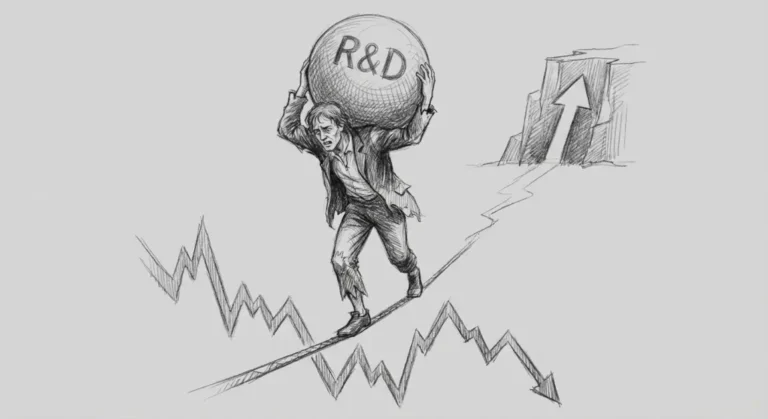
The R&D Line That Keeps Expanding
R&D spending rose to $54.2 million in 2025, up from $43.2 million in 2024. As a share of revenue, that moved from 6.8% to 7.3%.
Against total operating income of $55.2 million, the R&D line is nearly equivalent in size. Repligen is, in effect, plowing almost every dollar of operating profit back into development, which can be read either as visionary capital allocation or as a signal that the core business isn’t as self-funding as the headline income number suggests. The answer depends entirely on what those R&D dollars produce — and on that question, the current financials offer no resolution. The weakest assumption embedded in the bull thesis may be that this level of R&D spending translates into margin-accretive products on a timeline the market will reward, though the company’s track record of commercializing filtration and chromatography tools suggests it has earned at least some benefit of the doubt.
Capex-to-revenue fell to 3.2% in 2025 from 4.0% in 2024. Infrastructure spending is compressing as the R&D line expands. That tradeoff could mean Repligen is shifting its weight toward intellectual property over physical capacity — a sensible move if the next wave of demand comes from cell and gene therapy tools, where the differentiation is in the science, not the plant footprint. Alternatively, it could mean the company is simply spending less because the prior capacity buildout is sitting underutilized. The current disclosure doesn’t make it easy to distinguish between these interpretations, though a bull would note that management is allocating capital where long-term returns are highest.
Thermo Fisher Scientific, with 2025 revenue of $42.5 billion and an operating margin of 18.2%, operates at a scale where bioprocessing is one vertical among many, and a demand downturn in any single end-market barely registers in aggregate results. Waters Corp runs leaner and generates its 26.5% margin from a more focused analytical instruments franchise. Repligen sits in neither category — concentrated enough to feel sector volatility acutely, but diversified enough within bioprocessing that no single product line tells the whole story. That positioning is precisely why the drawdown from $175 was so abrupt, and it’s also why the potential for a sharp recovery remains structurally intact if the cycle turns decisively.
Cell and Gene Therapy: The Variable Nobody Has Quantified
The more structurally interesting variable isn’t the current margin profile — it’s the pace of adoption in next-generation bioprocessing modalities. Cell and gene therapy manufacturing requires a different set of tools than traditional monoclonal antibody production, and Repligen has been positioning its product development toward that opportunity for several years. Customer budget scrutiny in the CGT space has persisted well beyond what most forecasts anticipated, however, and the capital expenditure decisions of early-stage CGT companies remain highly sensitive to funding conditions in biotech venture markets. If the uptake of these new modalities stays sluggish through 2026, Repligen’s R&D investments will look premature rather than prescient, and the revenue trajectory that justifies a re-rating back toward $140 or beyond becomes harder to model with confidence. Yet even a modest thaw in CGT capital spending could unlock outsized demand for exactly the product categories where Repligen has been building its pipeline.
That $55.2 million operating income figure carries the most structural weight in this analysis — not because it’s large relative to the stock’s implied enterprise value, but because of what it means at the margins. If operating income grows 30% in 2026, to roughly $72 million, the margin profile starts to look like a specialty tools business earning its multiple. If it stagnates, or if R&D and restructuring costs absorb the revenue growth, the stock’s current $120 level may not represent the discount it appears to be. The cyclical trough is reflected in the price; the structural upside of the R&D pipeline is not yet.
$115.30 to $120.10 in a month. The direction has changed.
Can Repligen expand operating margins from 7.5% toward something resembling its peer group while simultaneously sustaining R&D investment at a rate that keeps its product pipeline competitive in next-generation bioprocessing — and do both of those things before the market’s patience for the recovery narrative runs out?