Three months ago, MARA was trading at $10.60. Today it’s $8.70. That’s not a crash — it barely registers as a correction — but the direction is unambiguous, and the reasons behind it are messier than a simple Bitcoin chart would suggest.
The market has settled on a clean story: MARA is a leveraged Bitcoin play, so when Bitcoin moves, MARA moves harder. Buy it if you’re bullish on crypto. Avoid it if you’re not. Comfortable. Wrong in the ways that matter.
The Number That Actually Runs This Business
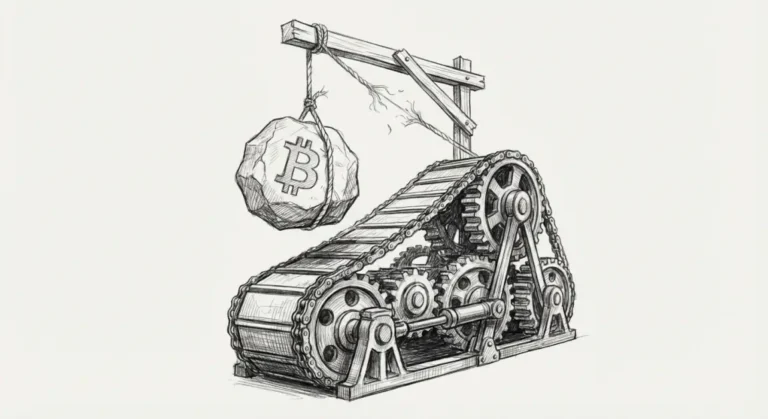
Hash price — revenue per unit of hash rate — has been quietly compressing for months as the global network hash rate climbs and more machines chase the same block rewards. According to MARA’s most recent filings, capital expenditure rose to $407 million in fiscal 2025, up from $251 million in 2024. That’s a 62% jump in spend on infrastructure that generates returns only if the economics of mining cooperate. They haven’t been cooperating. Hash price at historically depressed levels means MARA is running faster on a treadmill that keeps speeding up, and the market isn’t focused on that. It’s watching the Bitcoin ticker instead.
Unpack the $407 million figure. It’s not just large in absolute terms — it represents a strategic bet that expanding hash rate will eventually outrun the compression in per-unit revenue. If hash price recovers, the bet pays off. If it stays low, or falls further, MARA has built an enormous machine that earns diminishing returns on every petahash it generates. A 10% further decline in hash price doesn’t merely shave margins — it attacks the fundamental premise of the entire expansion. A 10% recovery, on the other hand, might not be enough to service the debt load that funded the capacity. The asymmetry here is uncomfortable.
$3.2 billion in long-term debt, per MARA’s balance sheet. Sit with that number without interpreting it.
Fiscal 2025’s operating loss came in at $1.2 billion according to the company’s annual report, which sounds catastrophic until you see it’s largely driven by $773 million in depreciation and $109 million in impairment charges. Non-cash, yes. But depreciation on mining hardware isn’t an accounting fiction — it reflects real equipment aging out of economic usefulness. When the machines stop being profitable to run, the depreciation was always telling you something. Revenue for fiscal 2025 hit $907.1 million, up from $656.4 million the prior year. Growth on the top line while the bottom bleeds.
Leverage Isn’t Just a Multiplier — It’s a Timer
The Bitcoin “hodl” strategy that management promotes is real enough. MARA holds Bitcoin on its balance sheet as a long-term asset, and in a sustained bull market, that position becomes enormously valuable. Bullish analysts lean on this hard. The implicit argument: MARA is building a Bitcoin treasury while simultaneously expanding its mining footprint, two compounding asymmetric bets in one stock.
Here’s where the contrarian case gets uncomfortable for the bulls. A prolonged market downturn — one where Bitcoin drops and stays down for twelve to eighteen months — creates a scenario where servicing $3.2 billion in debt requires liquidating the very asset the strategy is built around. The treasury becomes the emergency fund. The “hodl” becomes a forced sale. Not inevitable. Not even probable in the near term. But the weakest assumption baked into MARA’s current structure is that Bitcoin never stays low long enough to force the company’s hand on its treasury holdings — and that’s an assumption, not a fact.
The 52-week range runs from $6.70 to $23.50. A $16.80 spread on an $8.70 stock. The high wasn’t some distant historical anomaly — it happened within the last year. MARA’s price can move violently in either direction, which is exactly the point: this isn’t a stock where moderate views survive. You’re either positioned for a Bitcoin supercycle and MARA’s operational bets paying off simultaneously, or you’re watching a heavily leveraged miner get slowly compressed between rising difficulty and a debt load that doesn’t flex.
Competitors like RIOT and CleanSpark face similar industry-level hash price pressure — the compression is structural, not company-specific. But the debt profiles diverge sharply. MARA’s $3.2 billion in long-term notes puts it at a different point on the risk curve than peers who scaled more conservatively. If hash price rebounds, MARA’s operating leverage works in its favor harder than almost any other miner. If it doesn’t, MARA’s cushion is thinner. Same industry, meaningfully different exposure. The market tends to trade the sector as a monolith during volatile stretches, which overstates the correlation and understates MARA’s idiosyncratic risk.
Worth being honest about the counter-scenario: if Bitcoin breaks meaningfully higher — sustained above $90,000 — hash price math improves, MARA’s treasury appreciates, and the debt load looks manageable against rising revenue. Add a scenario where mining hardware efficiency improves faster than anticipated, reducing the effective cost per Bitcoin mined, and the bear case erodes quickly. Institutional appetite for leveraged Bitcoin exposure through equities rather than ETFs could drive significant inflows into MARA specifically, compressing the discount implied by current prices. Either of those conditions would make this column look overly cautious.
MARA can sustain the current structure if conditions remain roughly stable or improve. The stress test isn’t today’s Bitcoin price — it’s whether hash price recovers before the debt structure demands attention. That’s a race the market hasn’t fully handicapped.
At $8.70, the share price isn’t screaming distress and isn’t pricing euphoria. It sits in an ambiguous zone where the stock reflects neither the bull case nor the genuine structural risk around hash price and leverage. The upside potential of the Bitcoin treasury is already partially priced in. The terminal risk of the debt-to-hash-price ratio is not.
The whole pitch is essentially: give us your money, we’ll buy a volatile asset with it, borrow three billion more dollars to buy machinery that prints that same volatile asset at a rate that’s getting worse industry-wide, and if everything goes right, you’ll make a lot of money. And they’re not even lying about any of it.