avg target 9.3% higher
₹5,000
L&T trades at 4,096.1 INR as of April 18, 2026, inside a 3-month range of 3,225.1 to 4,440.0. Analyst consensus sits at a 4,475.07 INR average target, with a ceiling of 5,000.00. The Street sees moderate upside. This analysis does not.
Consensus positions L&T as a direct beneficiary of India’s infrastructure supercycle. Order inflows are strong. Contract wins have landed. Government capital expenditure posture has been expansive. None of that is in dispute. What consensus models assume — and what this analysis disputes — is that a growing order book translates into expanding operating income. Two different variables. Input cost inflation and currency depreciation belong in the structural column, not the transient one.
Iron ore sits at $106.8 per metric ton as of April 18, 2026, near three-month highs after sliding to $99.6 in mid-February. Copper is at $6.11 per pound, up from $5.40 in mid-March. Both moved sharply in the same direction over the same six-week window. For an EPC-heavy firm like L&T (Engineering, Procurement, and Construction, meaning fixed-scope contracts where cost overruns land on the contractor), that simultaneous spike is a margin compression event in slow motion.
Decompose the operating income risk directly. Structural steel on large infrastructure projects tracks iron ore with a lag of roughly one to two quarters. Electrical systems — cabling, transformers, motor assemblies — track copper more immediately. If iron ore holds at $106.8 and copper holds at $6.11, cost-of-execution on legacy fixed-price tranches rises without a corresponding revenue adjustment.
Escalation clauses exist in some contracts. They do not exist uniformly. Contracts awarded in prior cycles, when commodity prices were lower, carry no automatic pass-through. Those are the contracts currently being executed. Revenue is being recognized on old price assumptions. Costs are being incurred at new commodity levels. That gap is operating margin. Move iron ore 10%, from $106.8 to $117.5, and structural steel procurement cost on a mid-sized infrastructure package shifts materially. Move copper 10%, from $6.11 to $6.72, and electrical integration costs follow.
Currency compounds the margin problem. The rupee trades at 92.9 against the dollar as of April 18, 2026, per RBI data. High-specification components — tunnel boring equipment, specialized sensors, imported control systems — are priced in dollars. At 92.9, every dollar-denominated procurement line is roughly 3-4% more expensive than when many of these contracts were scoped. DXY at 98.2 is softening, offering marginal relief to global dollar liquidity, but it does not directly protect L&T’s import bill. Rupee trajectory is driven by domestic inflation and current account dynamics, not the dollar index.
Over the next 2-3 quarters, order book growth will continue to outpace operating income improvement unless L&T demonstrates that escalation clauses in new-vintage contracts cover current commodity levels and the rupee stabilizes below 92.
Q4 FY2026 earnings on May 6, 2026 is the first hard test. Working capital is the number to isolate. When large EPC firms accelerate order execution under cost pressure, accounts receivable typically expand faster than revenue. That pattern signals a shift toward cash-heavy, lower-margin delivery cycles rather than high-margin engineering services. If receivables spike relative to revenue recognized in Q4 FY2026, the quality of the order book narrative weakens regardless of the headline inflow figure.
One risk to this view deserves honest treatment. If commodity prices reverse — iron ore back toward $99, copper back toward $5.40 — the margin compression thesis loses its immediate catalyst. Both retreated in February. They could retreat again. The government’s capex pipeline is also not purely discretionary; multi-year committed programs carry their own budget inertia. A fiscal pivot toward social spending is a medium-term risk, not a Q1 event. The Street may be right that near-term order momentum justifies the current multiple, even if operating income lags.
A second, quieter structural risk sits beneath the cycle. The government fiscal multiplier — the degree to which public capex crowds in private investment and sustains capital goods demand — is not a constant. India’s infrastructure spending cycle has run hot for several years. A reorientation toward transfer payments or subsidies in an election-sensitive fiscal year compresses the addressable pipeline for firms like L&T faster than the order book suggests.
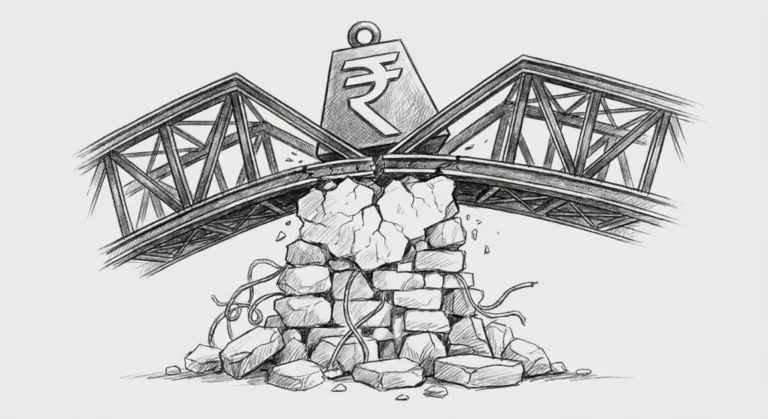
Against consensus, the market is pricing L&T as though revenue recognition from order inflows is the primary variable. Operating income does not automatically follow order inflows when raw material costs are rising and legacy contracts carry no escalation. The gap between booking and earning is where margin goes to die on fixed-price EPC work.
For the current valuation at 4,096.1 INR to hold, L&T must demonstrate on May 6, 2026 that new-vintage contracts carry sufficient escalation protection to absorb $106+ iron ore and $6.11 copper, and that working capital has not expanded disproportionately to revenue. If either condition fails, the distance to the 3-month low of 3,225.1 INR becomes a more relevant reference point than the consensus target of 4,475.07. The order book is solid. The margin story is not.