The dominant story on HDFC Bank right now is FII selling. That’s the narrative. Institutional money rotating out of India, high-weightage names taking the hit disproportionately, and HDFC Bank sitting at ₹756.2 on March 27 — roughly 2% above its 52-week floor of ₹741.1. The stock has shed nearly a quarter of its value since January. The NIFTY 50 is down about 12% from its three-month high. The rupee is at ₹94.7 to the dollar. It looks bad. The narrative writes itself.
But the FII flow story, while real, is also a distraction. Foreign institutional selling explains the price. It doesn’t say much about the bank.
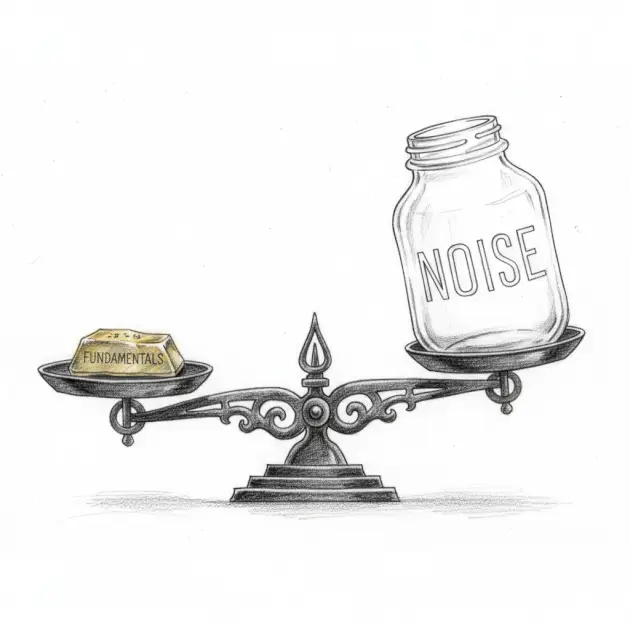
What the market keeps cycling back to — governance letters, exit headlines, global macro pressure — is mostly noise sitting on top of something quieter and more durable. HDFC Bank’s actual structural story is about its loan-to-deposit ratio, and almost no one is talking about that.
## The Ratio Nobody’s Watching
When HDFC Bank absorbed HDFC Ltd. in 2023, it inherited a balance sheet heavily funded by market borrowings rather than retail deposits. That’s fine for a housing finance company. It’s less ideal for a commercial bank trying to defend net interest margins in a rate environment that keeps staying higher than expected. The merged entity came in with an elevated loan-to-deposit ratio, and the bank knew it.
What’s happened since is a deliberate, unsexy pivot toward deposit mobilization. Branch expansions. Retail deposit campaigns. A conscious decision to slow down high-risk unsecured lending precisely as the RBI started tightening supervision on that segment. None of this moves a stock on a Tuesday. All of it matters for where margins go over the next two to three years.
Here’s the part worth holding onto: if the rate environment stays higher-for-longer — and there’s no strong global consensus that it won’t — banks that have locked in a stable, low-cost deposit base are the ones with the most room to run on NIM expansion. HDFC Bank is building that base now, during a period when the stock is being punished for reasons that have little to do with lending quality or deposit growth.
Morgan Stanley still carries an Overweight on the name. That’s not a guarantee of anything, but it reflects that at least some institutional analysis is looking past the flow data and toward the balance sheet trajectory. The thesis is straightforward: post-merger integration costs are not permanent, synergies take time to surface, and the current valuation discount to historical norms is pricing in a structural deterioration that isn’t actually in the numbers.
## What the Price Is and Isn’t Saying
HDFC Bank opened 2026 at ₹991.7. By March 27 it was at ₹756.2. That’s a steep move — the kind that in a different environment would trigger a serious reassessment of the underlying business. But the business hasn’t changed that dramatically. Credit growth is steady. Deposit mobilization is progressing. The integration is messy in the way that all large mergers are messy, but nothing has broken.
What changed is the context around the stock. Brent crude pushing toward $80 puts pressure on India’s trade deficit. A rupee at ₹94.7 to the dollar makes imported inflation stickier and gives foreign investors another reason to reduce exposure. The NIFTY correction is broad-based. In that environment, a large, liquid, high-index-weight name like HDFC Bank becomes a source of funds. You sell what you can sell, not necessarily what deserves to be sold.
That’s the mechanism behind the price action. It’s not a verdict on the bank.
The 52-week range is ₹741.1 to ₹1,020.5. The stock is sitting near the bottom of that range while the business case looks closer to the middle of its historical distribution. That gap between price and fundamentals can persist for a while, especially when macro headwinds are strong enough to overwhelm stock-specific logic. But it tends to close in the direction of price catching up to fundamentals, not the other way around.
The entry point argument isn’t that HDFC Bank is cheap by some absolute measure. It’s that the current discount reflects a set of temporary pressures — FII rotation, governance headline noise, integration overhang — that are being treated as permanent. The weakest assumption in this thesis is the word “temporary”: if India’s macro deterioration deepens or global risk appetite stays suppressed through the end of the year, these pressures compound rather than fade. As post-merger costs stabilize, as deposit ratios improve, as the rate environment eventually clarifies, the market will have fewer reasons to apply a structural discount to a bank that is, by most measures, running its core lending business competently. The macro headwinds are already priced in; the balance sheet improvements are not.
The timeline on that is uncertain. Anyone claiming to know exactly when FII flows reverse or when global rate expectations settle is guessing. What’s less uncertain is that the loan-to-deposit ratio improvement is measurable, the deposit mobilization strategy is visible in the quarterly data, and the credit quality hasn’t deteriorated in the way the stock price implies it should have.
There’s a reasonable version of this where HDFC Bank at ₹756 in late March 2026 looks, in two years, like one of those periods where a good bank was temporarily mispriced because global money was doing something else. There’s also a version where macro pressure persists long enough that the wait is painful. Both are honest. The bull case isn’t that the pain stops tomorrow — it’s that the business underneath the price action is more stable than the chart suggests.
The stock is near a 52-week low. The bank is near the beginning of realizing why the merger made sense. Those two things are both true right now, and only one of them is likely to matter in three years.
The whole conversation about FII selling and governance letters is the financial press doing what it always does — explaining yesterday’s price with today’s headlines, and calling that analysis.
Tags: HDFC Bank, HDFCBANK, Indian Banking, Credit Growth, FII Selling