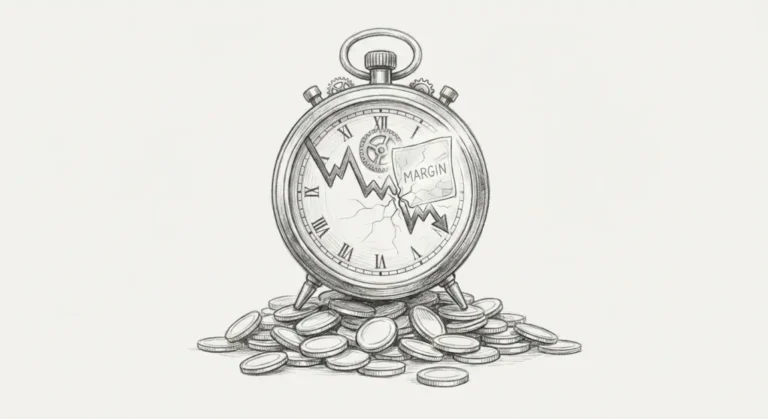
On April 4, 2026, the prior analysis flagged deposit cycle duration as the variable the market was treating as background noise — that assessment has not aged out. HDFC Bank sits at ₹810.3 as of April 11, 2026, roughly 20% below its 52-week high, while the Nifty 50 has shed approximately 1,750 points since February. The distance between current price and prior peak is a measurement.
This entire article is about one variable: net interest margin sensitivity to the duration of high-cost deposits.
Loan growth of 17% year-on-year in gross advances, reaching ₹25 lakh crore as of Q4 FY26, is the visible number — the one cited in analyst decks and screener headlines. Deposit composition is the less-visible counterpart. When the liability side of a bank’s balance sheet fills with high-cost term deposits accumulated during a tight liquidity cycle, margin expansion does not follow loan growth automatically. The two can diverge for quarters before the spread resolves. HDFC Bank’s scale — the largest private sector lender in India by assets — does not exempt it from this dynamic. It merely slows the transmission.
What Deposit Duration Repricing Does to Earnings
Net interest margin, the spread between what a bank earns on loans and pays on deposits, is the single number this thesis pivots on. HDFC Bank’s reported NIM has historically ranged between 3.5% and 4.2% over multi-year cycles. A 30-basis-point compression from the upper band to the lower band, applied to an asset base of HDFC Bank’s current scale, translates to several thousand crore rupees in foregone net interest income annually. If current policy rates hold elevated for another two to three quarters — a live possibility given the Reserve Bank of India’s stated inflation posture — and if the bank’s deposit repricing cycle has not yet fully run its course, margin pressure could persist into FY27 without any deterioration in credit quality or loan demand. A cyclical headwind, not a structural impairment of the bank’s franchise.
Move NIM 10 basis points in either direction and the earnings picture shifts materially. At the upper bound, HDFC Bank’s valuation case strengthens considerably — the market is paying for a bank that earns efficiently, not just one that grows. At the lower bound, the price-to-book multiple compresses regardless of headline loan growth, because return on equity begins to soften. The current price implies the market has partially acknowledged this risk without fully pricing the downside scenario through.
The thesis breaks if the RBI holds rates elevated through all of FY27.
The INR at 92.96 per USD as of April 11 adds a secondary layer. Foreign institutional investors — who have demonstrated sustained caution in recent months — evaluate Indian banking equities partly through a currency-adjusted return lens. A weak rupee erodes USD-denominated returns even when the underlying bank performs adequately in local currency terms. This constrains the pace of FII re-entry, which historically has acted as an accelerant for Bank Nifty rallies toward resistance levels like 56,000.
The counter-scenario is concrete. If the RBI pivots to a rate-cutting cycle earlier than the market currently expects — driven by softening domestic inflation or external demand slowdown — deposit repricing accelerates in HDFC Bank’s favor. Term deposits locked in at elevated rates mature and reprice lower. NIM recovery becomes the story. At that point, the 17% loan growth number, which has been somewhat discounted due to margin anxiety, re-emerges as a pure positive. The stock’s path back toward ₹950–₹1,000 becomes a function of timing, not probability. That scenario is plausible, though not the base case the data currently supports.
₹810.3 Against the 52-Week Geometry
₹810.3 sits approximately 11% above the 52-week low. The spread between current price and the prior high is roughly ₹210. That gap does not close on loan growth alone.
Margin stabilization — not expansion, just stabilization — coinciding with a normalization of Nifty 50 sentiment is what the bull case requires. Both conditions are achievable. Neither is imminent based on available data.
HDFC Bank’s balance sheet defensibility is not in question. The deposit franchise, the distribution footprint, the asset quality discipline across cycles — these are structural attributes. The question is whether those attributes justify paying up from current levels before NIM trajectory becomes legible. The cyclical margin compression is already priced in; the potential for a swift NIM recovery and subsequent valuation re-rating is not yet.
Patient accumulation at or below ₹810 carries different risk geometry than chasing a Bank Nifty technical breakout narrative.
The deposit clock is running. The market is watching the loan line.