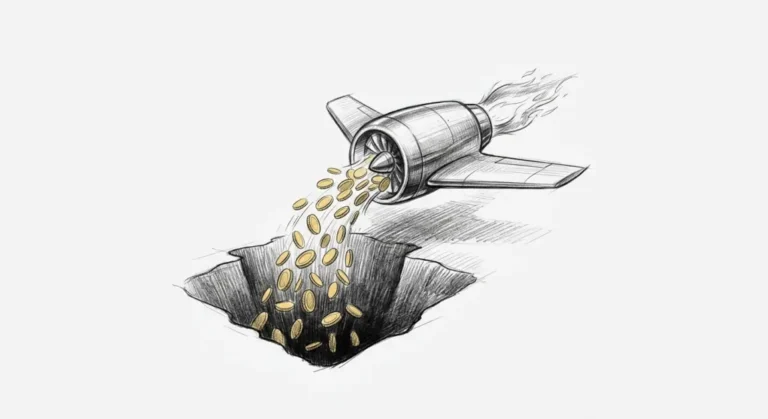
Here’s what caught my attention: a stock ranked second by turnover on the French market in a single session, up nearly 9% on over 518 million EUR in trading volume, and it still sits roughly 16% below the consensus average target of 343.79 EUR (per Yahoo Finance). That’s not a stock the market has figured out. That’s a stock the market is still arguing about — and when I see that kind of divergence between momentum and valuation, I start paying closer attention.
The numbers Safran put up for FY 2025 are worth sitting with for a moment. Revenue came in at 31,189 million EUR, up from 27,716 million EUR the prior year, per the company’s reported figures. Operating income reached 4,107 million EUR on an operating margin of 13.17% — not a blowout, but steady and defended, which in aerospace manufacturing is almost more impressive than a blowout. The number I keep coming back to, though, is free cash flow: 4,483 million EUR, a jump of over 21% year-over-year. When a company this size grows free cash flow that fast without a corresponding spike in revenue leverage, it usually means something structural is happening in the cost base — not just a good quarter. Diluted EPS landed at 17.17 EUR, which against a current price of 296.70 EUR (per Yahoo Finance) puts the stock at roughly 17x earnings. For a business with this kind of cash conversion, that multiple feels like it belongs in a different decade.
What’s driving the margin defense is something I’d call the aftermarket flywheel. Safran’s installed base — particularly its LEAP engine platform — generates recurring service revenue that behaves more like a toll road than a factory floor. Original equipment sales are lumpy and capital-intensive; aftermarket contracts are sticky, high-margin, and largely insulated from the procurement cycles that make aerospace OEM economics so uncomfortable to model. This is the same logic that made certain industrial franchises nearly impossible to dislodge once the installed base reached critical mass. The market tends to value these businesses on near-term earnings rather than on the embedded annuity, which is exactly the kind of mispricing I find interesting.
On the cost side, there are real pressures worth acknowledging. Copper is sitting at 6.189 USD/lb (per Yahoo Finance commodity data), and for a company with Safran’s exposure to aerospace electronics and wiring, that’s not trivial. But the EUR/USD rate, currently at 1.1754 (per Yahoo Finance FX data), provides a meaningful mechanical offset — a stronger euro lowers the effective cost of dollar-denominated inputs, which for a European manufacturer importing US-priced materials is a quiet but real margin tailwind. Add to that the lean production discipline embedded in Safran’s operations, which tends to absorb commodity shocks before they show up in the income statement, and the margin trajectory looks more defensible than the raw input data might suggest.
The macro environment is doing Safran no harm either. Europe’s rearmament push — driven by security concerns that show no sign of softening — is translating into sustained defense budget increases across the continent. This isn’t a one-cycle procurement bump; it’s a multi-year structural commitment from governments that have, frankly, underinvested in defense capacity for a long time. For Safran specifically, that means order backlog visibility that extends well beyond what a trailing earnings multiple can capture. Institutional capital has noticed: defense remains the defining sector theme of 2026 (per 24/7 Wall St), and established contractors with proven production capacity are absorbing that capital at a rate that tends to compress risk premiums over time.
Consensus, per Yahoo Finance, puts the average analyst target at 343.79 EUR, with the high end reaching 400.00 EUR. At the current price of 296.70 EUR, the base case implies roughly 16% upside just to reach average expectations. If the aftermarket cycle continues to compound and defense procurement accelerates further, I think there’s a credible path toward the upper range of that target band. I’ve watched this pattern before — a cycle where a defense-linked industrial with strong cash conversion trades at a discount to intrinsic value while the market debates macro risks, then re-rates sharply once the earnings consistency becomes impossible to ignore. I’m not going to pretend I can time that re-rating precisely, but the direction seems clear enough to me.
If free cash flow growth stalls and operating margin retreats below 12% for two consecutive reporting periods, this bull case breaks down — that would signal the aftermarket flywheel is slowing, which changes the valuation story entirely.
The risk I’d flag most seriously isn’t copper prices or euro moves — it’s execution on the supply chain. Aerospace production ramp-ups have a long history of promising more than the supply base can deliver, and Safran is not immune to that. A meaningful production shortfall on LEAP deliveries would hurt both the OEM line and the forward aftermarket revenue it seeds. Euro strength, if it runs significantly further, could also create headwinds on the revenue side for contracts denominated in dollars, partially offsetting the procurement benefit. These aren’t thesis-killers in isolation, but they’re worth watching.
At 296.70 EUR, I’d rather own a cash machine the market is still arguing over than a consensus darling that everyone has already agreed is cheap.
Revenue: €31.2B · Op. Income: €4.1B
Net Income: €7.2B · FCF: €4.5B
EPS (trailing): €17.17 · P/E: 17.3x · EBITDA: €5.9B
Shares Outstanding: 418M · DPS: €3.35 · Div Growth: 15.5%
Tax Rate: 25% (France statutory) / 29.1% (effective)
Source: stockanalysis.com, Yahoo Finance · Price as of today
© The Nonexpert · Original