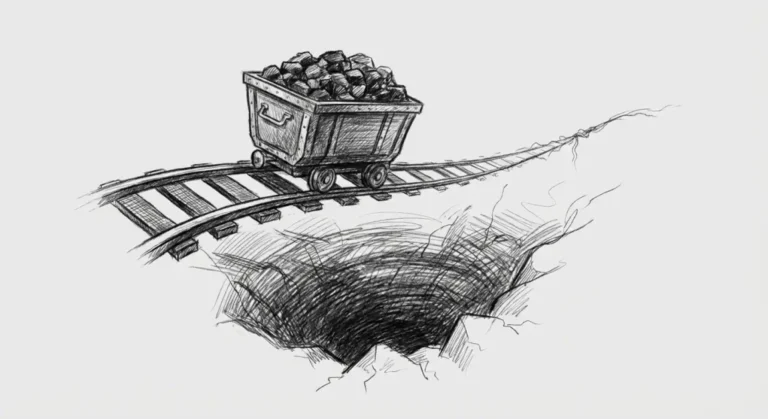
Coal India’s stock sits at 434.1 INR, its production volumes are rising, and the government treats it as a pillar of national energy security. And yet its operating margin has been contracting for years — a pattern the equity market continues to receive as an acceptable trade-off rather than a structural warning.
The consensus around Coal India runs something like this: dominant market position, essential commodity, policy backing, high dividend yield. The market tells itself this story with comfort, and it’s not entirely wrong. But the consensus is leaning on a premise that no longer holds — that cost absorption is temporary, tactical, and reversible. The evidence points the other way. Coal India’s pricing behavior has become institutionalized, not situational, and that distinction is where the long-term operating income story falls apart.
What Margin Suppression Actually Costs
Coal India does not set its coal prices through market discovery; it negotiates under implicit and explicit government pressure with power utilities that cannot absorb cost pass-throughs without triggering downstream electricity price increases, which creates a ceiling on realizations with no obvious expiration date. The company absorbs rising production costs — fuel, labor, explosive material, equipment maintenance — and passes almost none of it forward. Free cash flow, the measure of what a business actually generates after sustaining its operations, deteriorates even when production volumes climb. Volume growth in this structure flatters revenue, but it doesn’t fix the underlying operating income trajectory, and in some scenarios it accelerates the deterioration by adding cost without proportionate pricing relief.
But the bull case is not fabricated. Coal India moves roughly 600–700 million tonnes annually, commands over 80% of India’s domestic coal production, and sits inside an energy grid that has no near-term structural alternative. Thermal coal still generates the overwhelming majority of India’s electricity. The company’s position cannot be disrupted by a competitor in the conventional sense — there is no competitor. That monopoly-adjacent status provides a floor.
The spread tells the story.
Except the floor isn’t doing what investors assume. A company that cannot lose market share but also cannot raise prices functions as a throughput utility with equity listed on an exchange, not a durable compounder. The operating income generated per tonne — which is the number that actually matters here — has not kept pace with the nominal increases in extraction difficulty, deeper mine access requirements, and logistics strain. When the cost per tonne rises and the realization per tonne is constrained by policy, the spread compresses. That compressed spread is the thesis in one phrase.
The Rail-to-Road Drag on Internal Costs
There is a second layer to this that current market discourse barely touches: the rail-to-road transportation shift. A meaningful portion of Coal India’s output moves by road when rail capacity is saturated — which is frequently — and road transport is materially more expensive per tonne-kilometer, with Coal India absorbing much of that differential internally rather than passing it to buyers. At the volumes Coal India operates, even a modest shift in the modal split between rail and road creates a measurable drag on internal cost structure. The market is not pricing logistics efficiency as a variable; it is pricing volume and dividend yield while leaving the transport cost dynamic almost entirely out of the analysis. If the rail network expansion Coal India depends on lags — which India’s infrastructure timelines often do — the road freight exposure grows, quietly compounding the cost absorption problem from a direction the market isn’t watching.
Per-unit economics carry the most analytical weight here. When operating cost per tonne rises faster than the average realization per tonne, the entire equity case begins to rest on the hope that volume growth compensates for per-unit margin erosion. It has worked, intermittently, over the past several years; but the compounding effect is asymmetric, because cost inflation tends to arrive in irregular surges while realization increases require policy negotiation cycles that move slowly and often settle below inflation. A 10% move in operating cost per tonne, without a corresponding realization adjustment, translates directly into free cash flow compression at a scale that a company this size cannot easily offset through efficiencies alone. There is no precedent in Coal India’s history of the government permitting a large, rapid realization increase when the downstream electricity price implication is politically visible.
Over the next 12 months, Coal India’s operating margin will remain under pressure unless the central government explicitly permits a meaningful realization increase above input cost inflation — and there is no current policy signal suggesting that will happen before state election cycles conclude.
This breaks if India faces an acute power crisis severe enough that the political cost of a coal price increase becomes smaller than the political cost of electricity shortages — possible, but not base case. The thesis also breaks if global metallurgical coal prices spike sharply enough that Coal India’s blended realization rises even without a domestic policy change, a scenario that is external, not operational, and therefore not a structural fix.
Policy utility in practice. Commodity producer in valuation.
If Coal India is operating as a public utility in practice, at what point does its equity valuation reflect that reality rather than the earnings multiple of a commodity producer? The dividend yield is already priced in; the structural margin erosion is not.