THE NONEXPERT a view, not a verdict.

The Market Is Pricing Geopolitics. It’s Not Pricing the Crack Spread Problem.

WTI crude settled at $90.3 per barrel on March 24, 2026 — up 55% in roughly five weeks from a January low of $58.3. That move is extraordinary. But here’s the thing: the market is underpricing the wrong part of this crisis. Everyone is watching crude. The real trade is in what crude becomes once it hits a refinery, and right now, a critical piece of that conversion capacity just blew up. The primary signal driving this analysis is US crack spreads — the margin between raw crude oil and finished refined products like gasoline and diesel. Valero Energy Corp.’s major refinery explosion and subsequent shutdown has introduced a second-order … Read more

Amazon Trades at $211 While the Market Prices Zero Grid Risk Into Its AI Growth Story

Amazon closed March 23, 2026 at $211.1 — sitting 9.1% below its late-December high of $232.1, and nearly $48 off the three-month peak of $258.6. That’s a stock that has given back meaningful ground while the bullish story around it has, if anything, gotten louder. Barclays is calling for AWS growth acceleration driven by agentic AI demand. Analyst sentiment on hyperscalers broadly warmed through February and March. And Reuters confirmed on February 25 that Amazon’s reported $50 billion investment in OpenAI may be structured around milestone triggers — an IPO or the achievement of artificial general intelligence. The narrative is rich. The price action is flatter. That divergence is worth … Read more

The War-Risk Premium Nobody’s Pricing Correctly

The dominant read on this oil market is simple and wrong. Everyone’s calling WTI’s surge to $98.3 a barrel a “fear premium” — a temporary spike driven by Trump’s 48-hour ultimatum and Iranian saber-rattling that will mean-revert the moment diplomats get in a room together. That’s not what’s happening. The market is staring at a structural destruction of regional energy infrastructure, and it’s still treating this like a geopolitical headline risk that fades on Monday morning. The primary signal here isn’t the spot price. It’s war-risk insurance premiums on Suezmax and VLCC tankers in the Persian Gulf. These premiums have reportedly spiked to levels that change the effective cost of … Read more

The SMCI Smuggling Story Isn’t About Smuggling

Here’s the interpretation dominating the SMCI conversation right now: this is a catastrophic black swan — an impossible-to-predict, founder-level crime that destroyed shareholder value overnight. Clean narrative. Wrong conclusion. The co-founder arrest and the alleged $2.5 billion Nvidia GPU smuggling scheme to China isn’t the origin of SMCI’s crisis. It’s the confirmation of one. The primary signal to watch is not the legal exposure from the arrest itself. It’s the volume. On the day the smuggling charges broke, Super Micro Computer traded 242.96 million shares — a figure that dwarfs the stock’s typical daily activity, which over the preceding week rarely exceeded 30 million shares as of late March 2026. … Read more

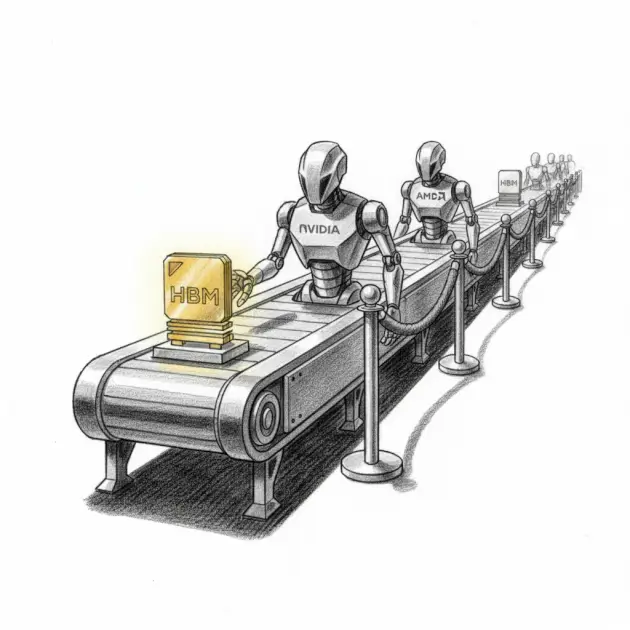
AMD’s HBM Problem Is the Real Story. The Stock Chart Is Just the Symptom.

Advanced Micro Devices closed at $201.3 on March 22, 2026, sitting 24.7% below its three-month high of $267.1 hit in late January — and the market is almost certainly not pricing in the right reason why. This is not about momentum. It’s about memory. The primary signal here is High Bandwidth Memory allocation tightness. HBM is the scarce, technically demanding ingredient that makes AI accelerators functional at scale. Without it, neither NVIDIA’s H100/H200 series nor AMD’s MI300X/MI350 lineup can train or run frontier models efficiently. The problem — and it’s one that AMD-specific analysis has consistently underweighted — is that SK Hynix and Samsung’s HBM production pipelines were already spoken … Read more

NVIDIA’s Agent Toolkit Is Not a Product Launch — It’s a Market Structure Play

NVIDIA is down roughly 20% from its January 2026 highs, the S&P 500 has just logged its fourth consecutive weekly loss, and JPMorgan has cut its year-end index target from 7,500 to 7,200 as of mid-March 2026. Into this backdrop, Jensen Huang stepped onto a stage at a major AI conference and did something that, on the surface, looked like an ordinary product announcement: he unveiled an Agent Toolkit for building specialized AI agents. The market shrugged. That’s the mispricing. What Huang actually did was lay the groundwork for NVIDIA to become the unavoidable tollbooth of the agentic AI economy — a structural shift that the current sell-off has completely … Read more

WTI at $98 and the Energy Complex Is Lying to You — Read the Fine Print

The real story in oil markets as of March 22, 2026 is not that WTI crude touched $98.23 per barrel. It’s that natural gas fell nearly 22% on the same day. That one divergence — crude sprinting toward $100 while gas collapsed from $3.965 to $3.095 — tells you almost everything about what this market actually believes. It’s more nuanced than the headline panic suggests. WTI has surged approximately 69% from its December 2025 close of roughly $58 per barrel. The immediate catalyst is Iraq’s declaration of force majeure on foreign-operated oilfields, tied specifically to Hormuz disruption stemming from the escalating Iran-linked conflict — confirmed by a Reuters exclusive on … Read more

Microsoft’s OpenAI Gamble Meets Stagflation Reality: Why the Market May Be Mispricing Both the Risk and the Escape Hatch

The VIX doesn’t lie. As of mid-March 2026, it’s reading 26.78 — almost exactly double where it started the year. That number alone tells you something significant has changed in how the market processes risk. Not panic. Sustained, institutional unease, the kind that doesn’t reverse on a single Fed statement or one decent jobs print. The 52-week range on volatility stretches all the way up to 60.13, worth keeping in mind: we’re elevated, but nowhere near the ceiling. The S&P 500 sits at 6,506.5 as of the week ending March 21, 2026, after completing a fourth consecutive losing week — down roughly 6.8% from its three-month peak near 6,978. The … Read more

The Gas Market Is Lying to You: Why Henry Hub’s Calm Is the Most Dangerous Number in Energy Right Now

Henry Hub natural gas futures are sitting at $3.10/MMBtu as of late March 2026. Taken alone, that’s a boring number — mid-range, unremarkable, the kind of print that wouldn’t wake up a sleeping trader. Nothing about this market is normal, though. And that $3.10, set against everything happening in global energy right now, might be one of the most misleading figures in markets. Just weeks ago, that same Henry Hub contract touched $7.46/MMBtu — a crisis spike representing roughly 184% above the three-month low of $2.62. The market panicked, priced in catastrophic supply loss, then decided it had overreacted. It hasn’t. The structural damage to global LNG supply is arguably … Read more

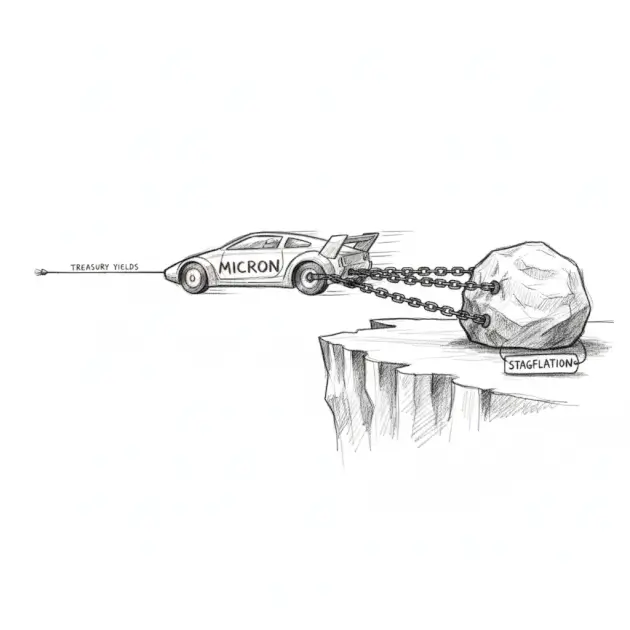
Micron’s Analyst Tailwind Meets a Stagflation Headwind — And the Automotive Memory Story Nobody’s Pricing

The number that should unsettle anyone building a near-term recovery thesis for Micron Technology is this: as of mid-March 2026, the US 10-year Treasury yield stood at 4.26%, having climbed from 4.05% at the start of the month — a 21-basis-point move in under three weeks. That’s not a gradual drift. That’s the bond market repricing risk in real time, and for a high-multiple semiconductor stock riding a post-earnings wave of analyst enthusiasm, that arithmetic cuts hard. The broader tape confirms the pressure. The S&P 500 has slid roughly 6% from its recent 3-month peak near 6,978, landing around 6,555 as of late March 2026. The Nasdaq Composite — the … Read more