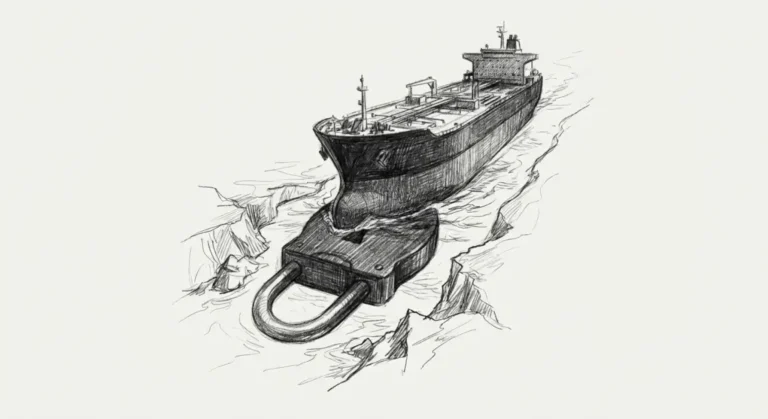
What happens to global energy markets when the price of oil is right but the cost of moving it is being quietly weaponized?
Brent sits at $114, WTI at $112, and most of the analysis stops there — at the headline number, the round figure, the thing Bloomberg puts in the ticker. But the Strait of Hormuz standoff has activated a secondary market that almost nobody outside the shipping industry watches in real time, and it’s the one that will matter most over the next six to twelve months.
Tanker insurance premiums for Persian Gulf transits are decoupling from crude prices. That decoupling is the catalyst.
The Number That Isn’t on Your Screen
Start with what’s visible. WTI moved from $57 in January to $112 by April — a near-doubling in roughly three months. Not a gradual repricing of demand expectations. A fear spike wearing a fundamental costume. Brent’s $114 handle reflects the geopolitical premium layered on top, the extra two dollars the market charges just for being the global benchmark crude while a chokepoint handles roughly a fifth of the world’s seaborne oil supply.
But the figure worth sitting with is the tanker insurance premium itself. War-risk insurance — the surcharge applied to vessels transiting conflict-proximate waters — has historically spiked during Gulf tensions, then collapsed just as fast when diplomacy intervened. What’s different now is that premiums are rising even on routes that don’t directly cross the strait. The radius of perceived risk has widened. Shippers are pricing in scenarios that haven’t happened yet, and that pre-emptive repricing functions as a tax on every barrel that eventually clears the Gulf, regardless of what Brent does on a given Tuesday.
Consider tanker insurance premiums moving 10% higher from current levels — a modest assumption given historical volatility during Hormuz confrontations. The landed cost of a barrel for a northeast Asian refiner absorbs that increment before the crude even touches a processing unit. Push them 30% higher, which Gulf crises have done before, and you’re looking at a cost-push that doesn’t show up in WTI quotes but absolutely shows up in downstream product pricing. Diesel. Jet fuel. Petrochemical feedstocks. The pain is distributed and delayed, which is exactly why it tends to be underpriced at the moment of origin.
The DXY at 100.1 should theoretically be providing some counterweight. A stable-to-firm dollar ordinarily suppresses dollar-denominated commodity prices by increasing the real cost for foreign buyers. It isn’t working. The physical supply constraint is overriding the currency transmission mechanism, which tells you something about the severity of the market’s read on Hormuz availability. When correlations break, the underlying force breaking them is usually worth paying attention to.
What Gets Priced In Next
The S&P 500 at 6,583, having retreated from a three-month high of 7,002, is starting to register this — but slowly, probably not fully. Equity markets tend to price energy shocks through the earnings channel, meaning analysts update refining margins, transportation costs, and consumer spending assumptions over weeks. The insurance premium channel doesn’t have a clean equity analog, so it largely goes unmodeled until a company reports it as a line item.
The catalyst isn’t the crude price. The crude price is already visible. Watch for the moment a major energy importer — a South Korean refiner, a Japanese utility, an Indian power generator — publicly breaks down the hidden cost structure of Gulf procurement and forces the market to reprice the full landed cost of a barrel rather than the extraction-point benchmark. That moment hasn’t happened yet. When it does, the conversation shifts from “what is Brent doing” to “what does it actually cost to receive a barrel in Busan or Chennai,” and those are different numbers by a margin that isn’t trivial. Once these insurance surcharges are baked into annual shipping contracts, they remain a persistent tax on global energy regardless of crude volatility.
Trailing behind crude insurance repricing, a second-order effect in LNG shipping deserves attention. Natural gas isn’t a Hormuz story in the same direct way, but the generalized “Gulf is dangerous” positioning raises war-risk premiums across the broader region. LNG tanker operators are already adjusting routing. Longer routes mean more vessel-days, tighter effective supply of shipping capacity, and higher spot freight rates — feeding back into European and Asian gas prices independent of any pipeline or production dynamic.
The thesis breaks under a specific set of conditions worth naming honestly. A genuine diplomatic de-escalation — not a ceasefire rumor, but a verified, brokered agreement that reopens the strait to normalized transit — would unwind the speculative layer in crude prices fast. The weakest assumption here is that insurance premiums stay elevated long enough to force a repricing; Gulf standoffs have a history of resolving faster than positioning anticipates. If premiums collapsed back to pre-tension levels within a six-week window, the “hidden tax” narrative dissolves and the secondary inflation channel closes before it’s ever fully priced. If US shale producers accelerate output in response to $112 WTI — economically rational at this price level — incremental non-Gulf supply could partially offset the bottleneck fear. Either scenario would make the current Brent premium look excessive in retrospect.
Energy-importing economies are not equally exposed. Countries with significant strategic petroleum reserves, diversified import sourcing, or domestic refining subsidies absorb the hidden insurance cost differently than those running lean on buffer stock. Japan and South Korea sit at one end of vulnerability; India, which has been buying discounted Russian crude through alternative routing, occupies a different point on that spectrum. That divergence in exposure is itself a pricing opportunity in regional energy equity baskets that most generalist funds aren’t structured to capture.
The crude price is the headline. The insurance premium is the article. Nobody’s reading the article yet.
We built the most sophisticated financial markets in human history, and the thing currently eating the global economy is a line item on a maritime insurance form that two guys in a Lloyd’s syndicate are updating every morning before anyone else wakes up.