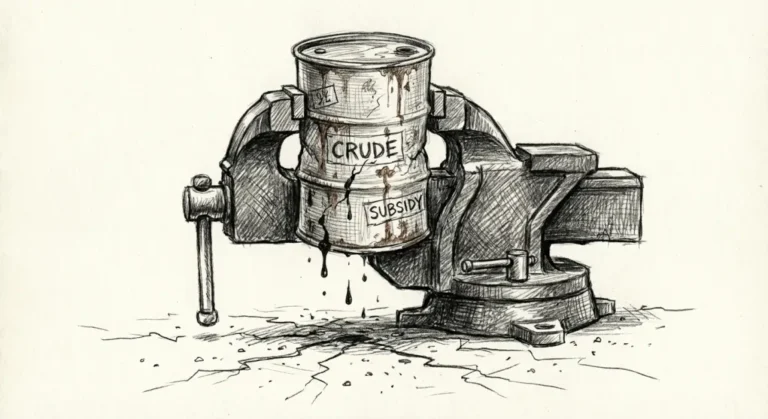
Something uneasy is settling over India’s energy trade. Traders aren’t panicking, exactly — but the bids on BPCL have been quietly drifting lower for months, and nobody seems eager to step in front of them. The psychology here isn’t fear so much as exhaustion: a sector already controversial for its price-cap structure is now staring down crude at levels nobody penciled into their models at the start of the year.
WTI hit $111.5 per barrel this week — nearly double the $62 it opened at in early January 2026 — and for a downstream refiner whose input costs are denominated in dollars while its output is sold in rupees at government-mandated prices, that amounts to a structural trap. BPCL shares have collapsed from ₹391 to ₹278 since the January peak, a 29% drawdown that tracks almost perfectly with the crude spike. The stock isn’t being punished for anything it did wrong. It’s being punished for what it cannot do: pass costs through.
The Number That Actually Matters
Focus on ₹93.3 per dollar for a moment, because this figure is doing more damage than the crude price alone suggests. Every barrel of WTI that India imports is invoiced in USD, which means the landed cost in rupee terms compounds the international price move. At ₹93.3/USD versus roughly ₹83 a year prior, the effective import cost per barrel is around 12% higher than the dollar-denominated headline suggests. If the rupee slides another 5% — not unreasonable in a risk-off environment with elevated oil import bills widening the current account deficit — BPCL’s under-recovery per liter widens further without a single additional dollar move in crude. Run it the other way: a 10% rupee appreciation would compress the landed cost even if WTI stays elevated. That’s not a prediction, just the math sitting there.
Meanwhile, the NIFTY 50 at 22,713 is threading a needle — not in free fall, but offering no shelter either. Broader market caution about inflation, fiscal pressure from energy subsidies, and weak consumption signals means BPCL isn’t getting the benefit of any rotation tailwind. It’s absorbing sector-specific pain in a market that isn’t generous to anything right now.
What Hasn’t Been Priced
Here’s the catalyst the market keeps dismissing: India has used strategic petroleum reserve releases before, and ethanol blending mandates have been accelerating. Neither is glamorous. Neither shows up in a refining margin calculation until it does — and when it does, the re-rating happens fast because nobody was positioned for it. An SPR release coordinated with supply normalization could compress the physical procurement cost for OMCs independent of WTI benchmark moves. Accelerated ethanol blending, already at 12–15% in parts of the Indian blend pool, reduces the volume of petrol OMCs need to produce from crude, which means the margin squeeze on that portion of the barrel simply disappears. These aren’t hypothetical policy tools. They’re in active use. What’s hypothetical is the timeline and the scale.
Harder to time but arguably more significant is a phased retail price revision. The Indian government has shown it will absorb pain for a stretch and then move — not in one shock, but in incremental ₹2–₹4 per liter adjustments that don’t make headlines individually but rebuild marketing margins over two to three quarters. Given that a national election cycle isn’t immediately pressing, the political cost of a modest price adjustment is lower than it’s been in years. The market is pricing in no revision. That’s probably wrong, even if the exact timing isn’t clear.
IOC and HPCL face the same headwinds structurally, but BPCL’s retail fuel exposure is proportionally higher relative to its refining throughput mix. That makes it more sensitive to marketing margin compression in the near term — and also means the leverage works violently in both directions. A ₹4/liter revision, applied across BPCL’s retail volume, doesn’t incrementally improve the story. It transforms it. That asymmetry is what’s absent from the stock at ₹278.
Still, the weakest assumption here is that New Delhi acts on pricing before balance sheet damage becomes entrenched — political incentives don’t always align with fiscal logic on any predictable schedule.
The thesis breaks under a few conditions worth taking seriously. If crude sustains above $110 through the third quarter of 2026 with no government intervention on pricing or fiscal compensation, BPCL’s balance sheet starts absorbing losses that can’t be papered over by optimism about future margin recovery. If the INR depreciates past ₹96–97 per dollar, driven by a widening current account deficit from the oil import bill itself, the landed cost math becomes genuinely difficult regardless of what New Delhi does on retail pricing. A global demand shock causing crude to collapse would flip the narrative entirely: OMC stocks would likely rally, but the SPR and blending catalysts become irrelevant, and the investment case reverts to a plain-vanilla recovery play rather than a structural re-rating.
What the chart tells you is that BPCL has given back everything it gained in the early-2026 re-rating cycle. Investors who bought the OMC story at ₹381 in January are now sitting on losses, which creates its own dynamic: capitulation selling provides the floor-testing that tends to precede value accumulation by longer-duration holders. Whether ₹278 is that floor is genuinely unclear. It could be ₹250. But the zone feels closer to exhaustion than to fresh distribution.
Ultimately, the government will let prices adjust — not because it wants to, but because a state-owned enterprise running sustained under-recoveries is a fiscal problem that surfaces somewhere else on the national balance sheet, and everyone in North Block knows it. The underlying misery of the margin squeeze is already priced in; the potential for a state-mandated repricing is not.
India keeps telling its state oil companies to sell fuel cheap and then acts surprised when the state oil companies have no money. That’s not an energy policy. That’s just a subsidy with extra steps and a stock ticker.