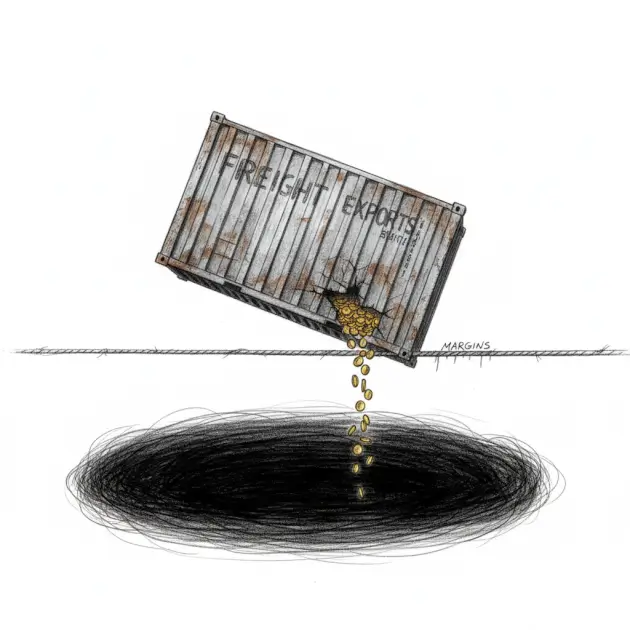
The UK recovery story for Tata Steel is already in the price. What isn’t in the price is the slow bleed happening on the other side of the balance sheet — in freight corridors, export lanes, and a demand picture that nobody in the bullish camp wants to stare at directly.
Tata Steel closed at 197.1 on April 1, 2026, according to Yahoo Finance. That’s 9% below the 52-week high of 216.5 reached in early March. The stock is not collapsing. But the 3-month range of 177.3 to 216.5 tells you something important: the market ran hard on the UK narrative, hit a ceiling, and has been quietly retreating ever since. That’s not a lazy drift. That’s someone deciding the story no longer justifies the price.
Analysts at Anand Rathi upgraded the stock on the back of an improved UK breakeven outlook, citing the realignment of steel import quotas to mirror EU policy. That’s a real structural development. The problem is that structural developments get priced in fast, and they tend to overshadow the slower, less photogenic risks that compound quietly until an earnings call makes them impossible to ignore.
The Freight Bill Nobody Is Reading
The silent variable here is Red Sea surcharges — not the headline-grabbing spike version, but the permanent, baked-in, this-is-just-what-shipping-costs-now version. Persistent Red Sea route disruptions have materially increased export freight costs for Indian steel producers. That figure isn’t getting smaller. It’s not a temporary disruption surcharge anymore. It’s a structural line item that the consensus UK-recovery model fails to account for with any seriousness.
Layer on top of that the INR/USD exchange rate sitting at approximately 94 per dollar, per ExchangeRate-API data. The textbook argument is that a weaker rupee is a gift to exporters. And in a clean model, it is. But when your coking coal imports are priced in dollars and your freight costs are surging in dollars, the rupee weakness that’s supposed to help you is simultaneously making your input costs more expensive. The net benefit shrinks. In some margin calculations, it disappears entirely.
Meanwhile, the NIFTY 50 has dropped from 26,147 in January 2026 to 22,898 as of April 1, per Yahoo Finance — a market-wide correction that reflects real demand anxiety in the Indian economy. That context matters. Tata Steel isn’t operating in a vacuum where the UK transformation shields it from a deteriorating domestic and global backdrop.
A House of Cards Built on Sand
Is this a permanent regime change or just a high-stakes shakedown that ends in a global demand crater? Export-oriented steel producers were counting on a global appetite that is visibly cooling. Chinese overcapacity continues to distort pricing benchmarks across Asian markets. Domestic competition is intensifying, with Emkay Global explicitly flagging a preference for SAIL and Jindal Steel over Tata Steel, citing domestic resilience as the differentiating factor. That’s not a minor footnote. That’s a peer comparison suggesting the market’s smarter money is already rotating toward less export-exposed names.
Indian demand cooling — whatever euphemism makes the conference call more comfortable — is the real price-killer here. Not the UK headlines. Not the quota realignment. The export market Tata Steel needs to lean on while the UK restructuring completes is precisely the market under the most pressure right now.
Tata Steel’s export margins are being squeezed from both ends simultaneously. Freight costs are up. Destination market demand is soft. The rupee depreciation that was supposed to be the cushion is being eaten by dollar-denominated input costs. This is the new operating environment, and it’s not yet fully reflected in how most sell-side models are built.
The only card left to play is the UK trajectory continuing without disruption while the global freight environment normalizes on a timeline that nobody can actually specify. The weakest assumption in the entire bull case is that freight normalization happens on any useful timeline at all. That’s a lot of faith to embed in a stock that has already given back 9% from its high, in a broader market down sharply since January. The UK restructuring is real. The quota alignment is real. The breakeven improvement is real. But the market already paid for those things at 216.5. What the current price at 197.1 is starting to price in is the possibility that the other side of the ledger is uglier than the upgrade cycle suggested. To be fair, if Red Sea disruptions do ease faster than expected, the margin squeeze unwinds quickly and the stock re-rates upward from here.
The next earnings cycle will make the footnotes loud. When these higher freight costs show up as margin compression in black and white, the conversation about whether the UK recovery “offsets” Indian export pressure will shift from analyst optimism to investor math. Those two things tend to reach different conclusions.
My read: the contrarian position isn’t to be bearish on Tata Steel as a business. It’s to be skeptical that the current price adequately compensates for the risks that the bullish narrative has made it fashionable to ignore. The freight bill is real. The demand softness is real. The competition preference from institutional desks is real. The stock price just hasn’t fully agreed yet.
The market spent months obsessing over a British steel plant getting its act together, while the actual margin story was happening on a cargo ship rerouting around Yemen — and nobody thought to check the invoice.