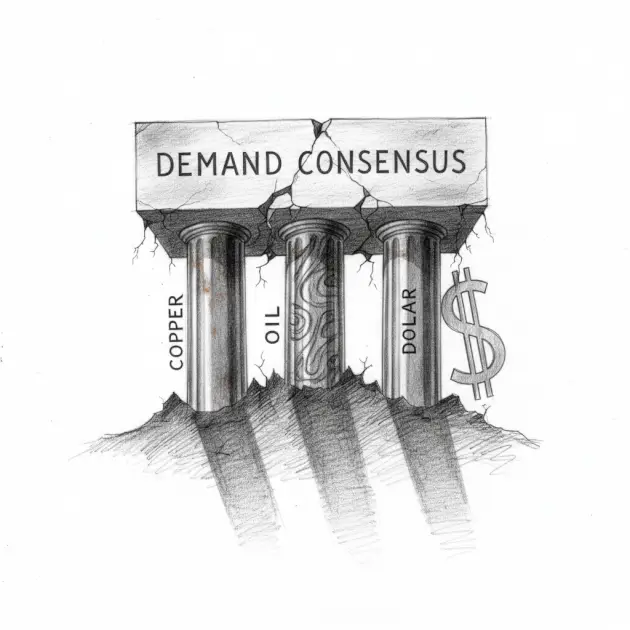
The consensus spent most of early 2026 convinced that global manufacturing was on its back. Copper was supposed to keep sliding. Oil was supposed to stay rangebound somewhere in the fifties. The dollar was supposed to stay king. Three months later, all three of those calls are looking costly.
As of March 29, 2026, copper settled at $5.5 per pound, holding more than a dollar above its 52-week low of $4.1 per Yahoo Finance. WTI crude sat at $99.6, one bad inventory report away from triple digits, against a 52-week low of $55.0. And the US Dollar Index had retreated to 100.2 from its 52-week high of 104.4. These aren’t minor reversals. Taken together, they describe a market that priced in a demand destruction that hasn’t fully materialized.
That’s the narrative the market is still catching up to.
What the Dollar Retreat Actually Unlocks
Start with the DXY, because it’s doing more work than it gets credit for. At 104.4, a strong dollar was quietly functioning as a tax on every commodity transaction settled outside the United States. For manufacturing procurement desks in Southeast Asia, Eastern Europe, and Brazil, dollar strength wasn’t a financial abstraction. It meant higher local-currency costs for every barrel and every ton of copper cathode they needed to source. Restocking made less sense. Inventory drawdowns continued.
At 100.2, that friction has eased. It’s not dramatic, but in commodity markets, marginal demand shifts move prices. When the cost of sourcing dollar-denominated materials drops even modestly for a large enough pool of buyers, the aggregate effect on physical flows can be meaningful before futures markets fully reprice. That part of this move may not be fully reflected in headline numbers yet.
There’s also a signal worth watching that almost no one talks about in earnings calls or analyst notes: physical warehouse premiums for refined copper. These premiums — the spread between what buyers pay for immediate physical delivery versus the futures contract price — often reflect genuine scarcity before the futures curve adjusts. They’re a blunt instrument, hard to track without direct access to trade data, and they rarely make headlines. But when those premiums rise, it means industrial buyers are willing to pay extra to get copper now rather than wait. If premiums are quietly firming alongside a $5.5 spot price, the futures market may still be underestimating the tightness in physical supply.
Oil at $99.6 Is a Positioning Story as Much as a Fundamentals Story
WTI’s move from $58.1 at the start of January to $99.6 by March 29 is not subtle. That’s a 71% run in under three months. The chart below makes the trajectory plain.
Per Yahoo Finance, 340,625 contracts traded on the most recent session — that’s not a thin, drift-higher kind of market. That’s a market with conviction behind it. The bearish read is straightforward: a move that fast is a short squeeze or a geopolitical fear premium, and it fades. Maybe. But the bull case doesn’t depend on the move being clean or justified by a single factor. It depends on whether the demand side holds as prices push higher. Right now, there’s no clean evidence that transport demand, industrial throughput, or refinery runs are buckling under $99 crude.
Rising oil at this pace does complicate the input cost picture for manufacturers. But the way the market is currently reading $100 oil isn’t as a stagflation signal — it’s reading it as a heat map for global activity. That interpretation can change quickly if consumer data starts cracking, but for now, the energy market is pricing growth.
The copper story is cleaner in this regard. Copper at $5.5 doesn’t carry the same inflationary baggage that oil does. It doesn’t show up directly in headline CPI the way energy does. What it does is tell you something about what industrial buyers expect to need over the next six to twelve months. Copper demand is tied to construction, grid infrastructure, electric vehicles, and capital equipment — the kind of spending that happens when someone, somewhere, has committed to building something. The fact that prices have stabilized well above the $4.1 low, rather than continuing to drift down, suggests those commitments haven’t collapsed.
The 52-week high for copper was $6.5. At $5.5, there’s meaningful distance between current prices and that peak. That gap is actually part of the bull case. The froth from whatever drove prices to $6.5 has been worked off. What’s left at $5.5 looks more like a base than a ceiling. If physical inventory drawdowns continue and the dollar stays soft, the path back toward $6.5 doesn’t require a new demand narrative — it just requires the current one to keep holding.
None of this is happening in isolation. The dollar, copper, and crude are telling roughly the same story from three different angles: global demand didn’t collapse the way the recessionary consensus expected, supply in both energy and industrial metals remained tighter than the models suggested, and the dollar’s retreat is now adding a second layer of fuel to a rally that started on fundamentals. The weakest assumption here is that the dollar keeps fading — a hawkish Fed pivot or a liquidity scare could reverse the DXY move fast, and the commodity bid that depends on it would go with it. The macro setup for commodity-linked assets over the next two quarters looks better than consensus positioning implies. The reversal off the lows is already priced in, but the fundamental tightness that can carry the rally higher is not.
There are risks. A dollar reversal, a demand shock out of China, or an energy supply release that breaks crude below $90 would all damage this thesis materially. Watch physical copper premiums. Watch weekly EIA inventory draws. Watch whether the DXY reclaims 102 or keeps fading. Those are the tells.
The funniest thing about commodity markets is that everyone ignores them until they’ve already moved 70%, and then they call it obvious.