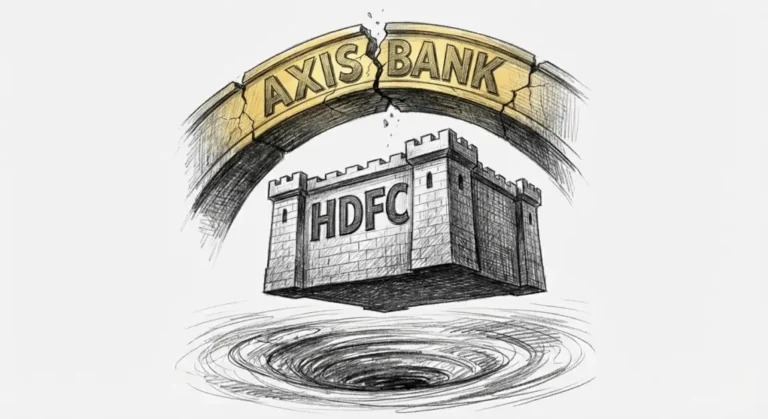
HDFC Bank reported net interest margins above 3.5% through most of 2024. It trades at a premium to book. Analysts cite its retail deposit franchise as a structural moat. The consensus view on Indian private banking leans heavily on HDFC as the benchmark: clean balance sheet, disciplined lending, insulated from PSU-style capital misallocation.
That consensus has bled into how the market prices the entire private banking cohort. Axis Bank carries the halo. Regulatory scrutiny stays aimed at PSUs. Liquidity managed. Yield spreads intact. The assumption is contagion stays on the other side of the fence.
Where Axis Bank Diverges from the HDFC Template
Axis Bank trades at 1,354 INR as of April 15, 2026. Its 52-week range is 1,042 to 1,418 INR. The stock sits near the upper end. March lows were 1,234 INR. Recovery from trough to current: roughly 9.7% in under four weeks. The SENSEX over the same period moved from 76,034 to 76,847, less than 1%. Axis outperformed its index by a wide margin on the way back up.
That divergence signals mispricing.
HDFC Bank’s margin premium is built on retail deposit depth. Low-cost current and savings account (CASA) ratios give HDFC structural insulation when wholesale rates move. CASA represents the proportion of deposits held in low-interest accounts, a proxy for funding cost advantage. Axis Bank’s CASA composition is thinner. Its yield spread management has historically leaned on more active liquidity deployment, including mechanisms the Reserve Bank of India is now examining: the unwinding of rupee arbitrage positions, where banks exploit short-term rate differentials to juice net interest income. The market is overweighting this variable as benign.
Rupee Arbitrage Scrutiny and NIM Exposure
Net interest margin, or interest earned minus interest paid divided by earning assets, is the single number that determines whether a bank’s operating income story is real or manufactured. For Axis Bank, the regulatory focus on how rupee arbitrage positions were built and unwound is a direct NIM risk. The scrutiny is sector-wide, not isolated.
Decompose NIM for any private bank: yield on advances minus cost of funds, adjusted for non-performing asset drag and off-balance-sheet items. If the arbitrage mechanism compressed cost of funds artificially by cycling short-duration wholesale paper through rate-differential windows, regulatory closure of that window raises the effective funding cost. A 20 basis point rise in cost of funds on a large loan book moves operating income materially. A 50 basis point move is structural, not cyclical.
HDFC Bank’s retail deposit base partially insulates it. Axis Bank’s balance sheet is more deeply integrated into corporate credit and wholesale funding cycles. In normal conditions, fine. When the regulator changes the rules on how those cycles are managed, it becomes a vulnerability. The claim that private banks are generically safer than PSUs survives only if the private sector’s yield management practices remain intact. That assumption is now under direct examination.
Over the next 2-3 quarters, Axis Bank’s operating income trajectory faces more pressure from NIM compression than from credit quality deterioration, unless the RBI’s arbitrage scrutiny resolves without mandating structural changes to wholesale liquidity deployment, which current sector reporting does not suggest.
The counter-scenario exists. If the regulatory review concludes without enforcement action, or if Axis Bank’s corporate credit book reprices upward fast enough to offset funding cost increases, the stock near 1,354 INR looks defensible. The 52-week low of 1,042 INR suggests the market has stress-tested the downside once. A clean regulatory outcome reopens the path toward 1,418 INR. This breaks if the RBI review turns out cosmetic. Sector reporting so far does not support that read.
Currency adds external pressure. The INR/USD rate at 0.0107 as of April 15, 2026 tightens the RBI’s room to ease. A tighter monetary environment extends the period of elevated wholesale funding costs. Axis Bank’s exposure to that channel exceeds HDFC’s.
The market assumes Axis Bank’s proximity to HDFC Bank’s business model means it shares HDFC’s structural margin protection. The funding architecture differs. The regulatory exposure differs. Price behavior looks similar. That gap is the trade.
HDFC Bank: CASA-driven NIM insulation, retail deposit depth, premium valuation with visible structural basis. Axis Bank: 1,354 INR, 9.7% recovery from March lows, SENSEX outperformance, and a NIM structure under direct regulatory review. Same sector, different risk profile, one price spread.