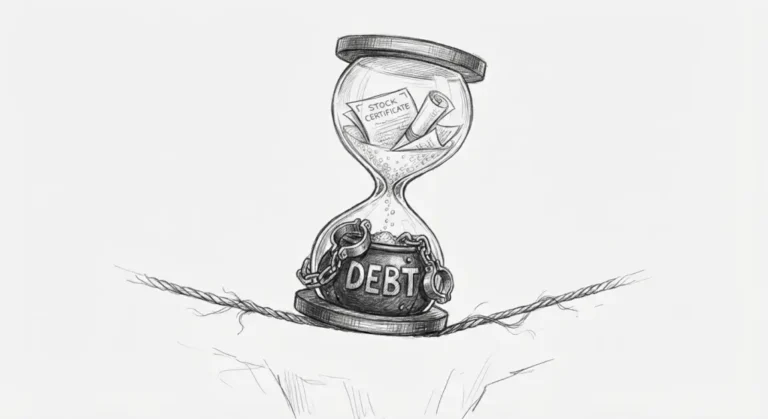
$867 million. That’s what TKO Group Holdings spent buying back its own stock in 2025, according to its 10-K filing — more than five times its 2024 repurchase spending. The stock has barely moved. Between January and April 2026, TKO traded in a narrow band between roughly $194 and $204. Not a buyback working. A buyback treading water.
The $1 billion repurchase announcement got the headline treatment it was designed to get. Markets read buybacks as confidence. Sometimes they are. Sometimes they’re the most expensive way a company can signal it’s run out of better ideas.
What the Balance Sheet Actually Says
Walk through the 2025 10-K and the picture grows more complicated than the press release suggests. Total long-term debt, including the current portion, sits at approximately $3.8 billion per the filing. Cash and equivalents came in at $831 million — up from $526 million in 2024, which looks like progress until you set it next to the debt load. A cash-to-debt ratio somewhere around 0.22. Not a crisis number. Not a comfortable one either.
Operating cash flow did something genuinely impressive: $1.3 billion in 2025 per the 10-K, up from $0.6 billion the prior year. More than doubled. That’s the number bulls are standing on, and they’re not entirely wrong to do so. The business generates cash. The question is where that cash goes next — and right now, almost entirely toward shareholders, not creditors.
Here’s the number worth sitting with. $867 million in buybacks against $1.3 billion in operating cash flow means TKO returned roughly 67 cents of every dollar generated from operations directly to shareholders in 2025. That ratio, if sustained, leaves almost nothing for debt reduction. In a year where rates stayed elevated and refinancing risk remained a live conversation for most leveraged balance sheets, that’s an aggressive posture. If operating cash flow drops 20% — not an outlandish scenario in a business tied to live events and media rights cycles — that ratio gets uncomfortably close to 80 or 90 cents on the dollar. The buffer compresses fast.
Of TKO’s total assets per the 2025 filing, $8.4 billion sits in goodwill. Over 54% of the balance sheet parked in an intangible — one reflecting what TKO paid for acquired businesses above their fair asset value. Goodwill doesn’t generate cash. It doesn’t service debt. It’s subject to impairment testing: if the acquired units underperform expectations, that number gets written down, and the equity cushion shrinks faster than the debt does. Not a theoretical risk. Leveraged media consolidations have ended exactly this way before.
The Peer Comparison That Deserves More Attention
Warner Bros. Discovery has spent the last two years getting ripped apart in the press for its debt load — rightly so. Las Vegas Sands carries leverage, but against hard physical assets: casino floors, hotels, infrastructure that holds value independently of any single revenue stream. TKO’s leverage profile occupies a different category entirely. Its assets concentrate in brand value, contractual rights, and goodwill from acquisitions. Those are worth exactly what future cash flows say they’re worth. No floor. No collateral in the traditional sense. The market has not priced that distinction in any meaningful way.
A genuine bull case exists, and it should be stated honestly. If media rights renewals for WWE and UFC come in strong — and the sports rights market remains heated — operating cash flow could stay elevated or grow. Live events have proven more resilient than recorded entertainment through consumer spending cycles. The higher cash balance in 2025 versus 2024 suggests some liquidity improvement is real, not manufactured. If TKO locks in long-term rights deals at favorable terms before any softening in discretionary spending, the operating cash flow engine stays intact and the buyback math looks less reckless in hindsight. That’s the scenario where this analysis breaks down: stable or growing cash flows, no impairment triggers on goodwill, a rights renewal environment that holds.
But the market treats the buyback announcement as confirmation of financial strength rather than as a capital allocation choice made under constraint. A company with genuine balance sheet flexibility might buy back stock. A company that has limited good options for deploying capital might also buy back stock. The behavior looks identical from the outside. The underlying condition — very different.
Media rights are the variable nobody models conservatively. TKO’s operating cash flow doubled in 2025, and a significant part of that story ties to how those rights get priced and renewed. The weakest assumption running through the bull case: that the buyer pool for premium live rights will look as deep in two years as it does now. Streaming platforms have burned through cash chasing content; some have pulled back. Linear television contracts structurally. The rights cycle for both UFC and WWE will come back around, and when it does, the negotiation happens in whatever media environment exists at that moment.
$203.80 on April 3, 2026. The stock flat from where it started the year. The buyback hasn’t re-rated the multiple. The operating cash flow improvement hasn’t re-rated the multiple. Either the market already reflects the debt concerns in the current price, or the market views TKO as a sports and entertainment asset with durable cash flows and discounts the balance sheet structure as manageable. Pick one. The operational success sits in the price; the structural risk of the leverage profile does not — at least not yet.
What’s harder to defend: framing $867 million returned to shareholders while carrying $3.8 billion in debt and $8.4 billion in goodwill as financial confidence rather than a specific choice about who gets paid first. Debt holders are senior. They get paid regardless of the narrative. Shareholders get what’s left. TKO voluntarily shrinks what’s left while the senior obligations stay fixed.
The buyback is real money. The debt is also real money. Only one of them disappears if the business softens.
The whole thing runs like a perfect little machine: borrow money to buy assets, book the premium as goodwill, generate cash from the assets, use the cash to buy back stock instead of paying down the debt, announce the buyback as a vote of confidence, watch the stock barely move, repeat. Shareholders get the press release. Creditors get the math.