avg target 23% lower
target high $150.00
$158.40 (current)
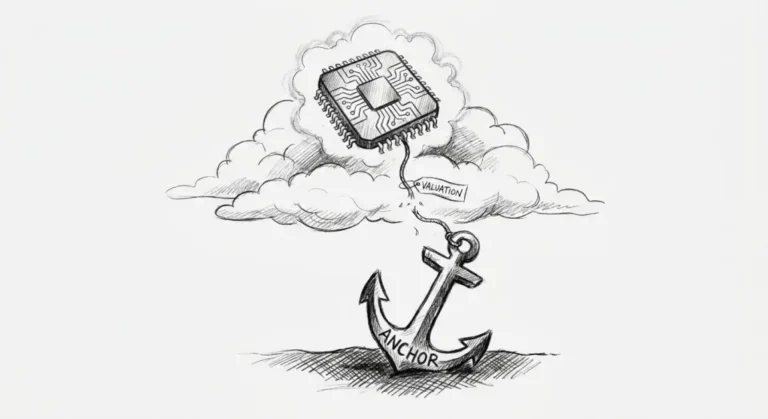
Rambus (RMBS) closed at $158.40 on April 24, per Yahoo Finance — a price that sits $36 above the average analyst consensus target of $122.00 and $8 above even the most optimistic individual target of $150.00, per Yahoo Finance consensus data. The stock touched a three-month low of $46.57 before this run, per Yahoo Finance, which means it has more than tripled off the trough in a matter of weeks. Free Cash Flow came in at $333.2M for FY 2025 (operating cash flow of $360.0M minus CapEx of $26.8M, per company filings), against a 47.1% FCF margin per stockanalysis.com — genuinely impressive numbers. Short interest sits at 8.5% of float, per Yahoo Finance. I want to be clear about what I’m looking at before I say anything else: the fundamentals are real, and the stock has still lapped them.
The consensus narrative right now is that Rambus is a clean AI infrastructure play — DDR5 memory controllers, HBM licensing, Intel Foundry Alliance tailwinds — and that the 36.8% operating margin (FY 2025, per company filings) justifies a premium multiple indefinitely. I think that story is about half right, and the half that’s wrong is currently doing most of the work in the stock price.
Here is where it gets complicated, and I want to sit with it longer than a bullet point deserves. Semiconductor capacity utilization in the US dropped to 69.7% in Q1 2026 from 76.1% a year prior, per FRED — that’s meaningful industrial slack, and it matters for Rambus even though the company doesn’t own fabs. Its IP licensing revenue is structurally tied to how many new design starts and foundry engagements its partners are committing to; when utilization softens, design activity eventually follows, and contract renewals get negotiated from a weaker posture.
The rate picture isn’t helping. The 2Y Treasury yield has climbed to 3.79% in April from 3.47% in February, per US Treasury and FRED data — a re-steepening of the short end that functions as an implicit discount rate headwind on Rambus’s long-duration royalty streams. For a business model heavily dependent on multi-year IP licensing, that’s not noise. Against both of those headwinds, you have hyperscaler capex on AI infrastructure that remains, by most accounts, genuinely undeterred — and Rambus’s DDR5 and HBM memory controller products sit directly in that spending path. So you have real demand, real margin compression risk, a softening utilization cycle, and rising rates all operating simultaneously. The stock is betting, at $158.40, that only the demand variable counts. I’m not so sure that’s how cycles work.
The one variable I think the market genuinely isn’t pricing correctly is the duration of existing foundry licensing agreements. IP licensing contracts — the kind Rambus structures with its foundry partners — typically run multi-year terms with fixed payment schedules. That means near-term utilization weakness doesn’t immediately translate into revenue weakness; the insulation is real, even if it’s temporary. This is worth acknowledging honestly, because it’s the best structural argument for why the stock might hold up even as the macro deteriorates around it. Nobody talks about when those contracts actually come up for renewal.
In FY 2025, Rambus reported revenue of $707.6M and operating income of $260.2M, per company filings. The stock at $158.40 is trading at a level that demands continued acceleration — not just maintenance — of those numbers. The 14.37% single-session gain that helped fuel this latest leg has short-covering fingerprints all over it given the 8.5% short float, per Yahoo Finance. A short-covering rally is a real rally right up until the shorts are done covering.
With the Q1 2026 earnings call scheduled for April 27, per company IR and Yahoo Finance, there will be a near-term test of whether operating income and licensing momentum can actually justify what the stock is already pricing in. If management signals that existing multi-year licensing agreements are insulating near-term results and guides toward meaningful revenue growth, my concern about the valuation gap becomes much harder to sustain.
The fundamentals at Rambus are genuinely good. The stock just stopped caring about fundamentals somewhere around $122.