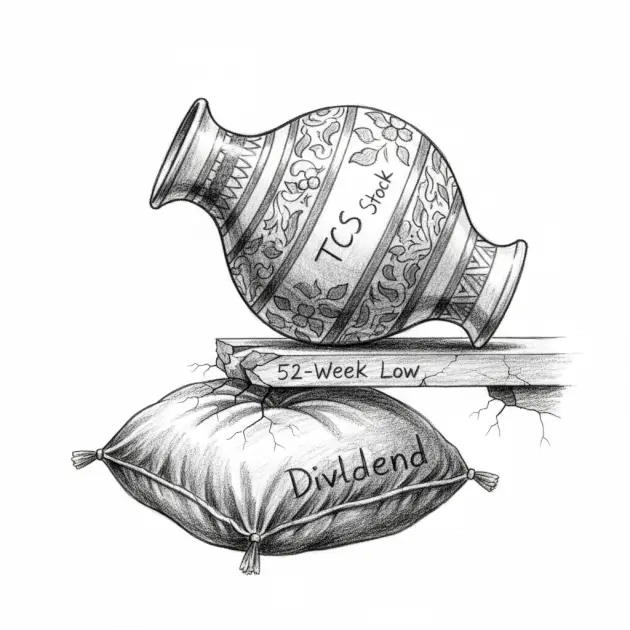
The board meeting is a formality. What matters is that TCS has lost 18% in a single month and is sitting two percent above its 52-week low while the rest of the market threw a party.
On March 25, 2026, TCS closed at 2,412.5 on the NSE. On February 25 it was at 2,941.6. That’s not a correction. That’s a sector telling you something. The Nifty 50 dropped 7.2% over the same window — painful, but orderly. TCS dropped more than twice that. The gap between those two numbers is the story, and no dividend announcement is going to paper over it.
TCS will hold its board meeting, consider a final dividend for FY26, and the financial press will write about management confidence in cash flow generation. Fine. But the stock is at 2,412 with a floor at 2,348. That’s not a lot of cushion between “dividend signal” and “52-week low.” If the earnings quality disappoints on April’s call, that floor gets tested the same afternoon.
The currency argument is the one bulls keep reaching for, and it’s not wrong — it’s just incomplete. The rupee hit 94.1 to the dollar as of March 25. Historically that’s a tailwind for TCS. You earn in dollars, you pay salaries in rupees, the spread works in your favor. That math hasn’t changed. What’s changed is that it apparently doesn’t matter right now, because the stock is still collapsing. When a historically reliable margin cushion stops translating into price support, you stop calling it a cushion and start asking what it’s failing to offset.
What it’s failing to offset is the demand side. The Nasdaq closed at 21,761.9 on March 24, down 6.4% from 23,255.2 on February 24. Global tech spend is contracting in the client base that TCS depends on. American enterprise budgets are under pressure — and with the Federal Funds Rate parked at 3%, the usual argument that rate cuts will unlock spending doesn’t apply here because rates have already come down considerably without reviving deal flow. When a CFO in Dallas decides to pause the digital transformation initiative for two quarters, that decision shows up eventually in Chennai’s utilization numbers. And utilization — specifically the cost of keeping skilled engineers on bench while deal flow slows — is exactly the kind of margin headwind that doesn’t get a line item in the earnings call. It gets absorbed into vague commentary about “investment in talent” and “ramp-up readiness.”
That’s the variable that flips everything here. Not the rupee. Not the dividend. Bench utilization. If TCS comes out of Q4 with offshore bench costs that have quietly ballooned while revenue growth decelerated, the currency tailwind was never going to save the margin story. We won’t know the real number because it’s not disclosed cleanly. We’ll get hints in the operating margin line and in how management talks about headcount versus revenue per employee. Watch that ratio on earnings day more than you watch the headline revenue figure.
The chart from December 2025 to March 2026 is almost a straight line down: 3,280, then 3,170, then 2,942, then 2,413. Four data points. No bounce worth noting.
HCL Technologies has also fixed its Q4 board meeting date, which tells you nothing except that the entire sector is lining up for a synchronized moment of truth. Wipro, Persistent Systems, Tech Mahindra — they’re all in the queue. The synchronization matters because it means the market will be pricing the sector in a compressed window. If TCS disappoints on FY27 guidance and HCL follows a week later with soft numbers, the de-rating accelerates. If one of them surprises, it probably lifts the others for a day. Either way, the next three to four weeks are when you find out whether this is a sector in cyclical distress or something with more structural weight to it.
My read is structural, with a cyclical trigger. The cyclical part is the Nasdaq slide and the client budget freeze — that could reverse in two or three quarters if enterprise confidence returns. The structural part is that AI-native development is starting to change how clients think about outsourcing headcount. If you can generate a first draft of code internally with AI tools, you need fewer external engineers on your payroll-as-a-service arrangement. TCS knows this. The market knows TCS knows this. The weakest assumption in the bear case is that AI displacement moves fast enough to dent FY27 revenue in a meaningful way — it might not, but the anxiety alone is repricing the stock. The question on every FY27 guidance call is whether management can articulate a credible pivot or whether they’re going to describe the old business in new language.
The one variable that genuinely flips this: a FY27 revenue guidance number that clears 10% growth with margin expansion. That would mean the demand picture is better than the Nasdaq slide implies, the bench costs are contained, and the rupee tailwind is actually flowing through to the bottom line. Short of that, the dividend is a consolation prize dressed up as a confidence signal.
They’re going to announce a dividend, hold a board meeting, and call it a pivotal moment for price discovery. Meanwhile, the stock is 3.5% above its 52-week low and the analysts will spend forty minutes on the call asking about AI strategy while the utilization slide sits quietly in the footnotes.
Tags: TCS, Q4 Earnings, Indian IT Sector, NSE, Rupee Depreciation