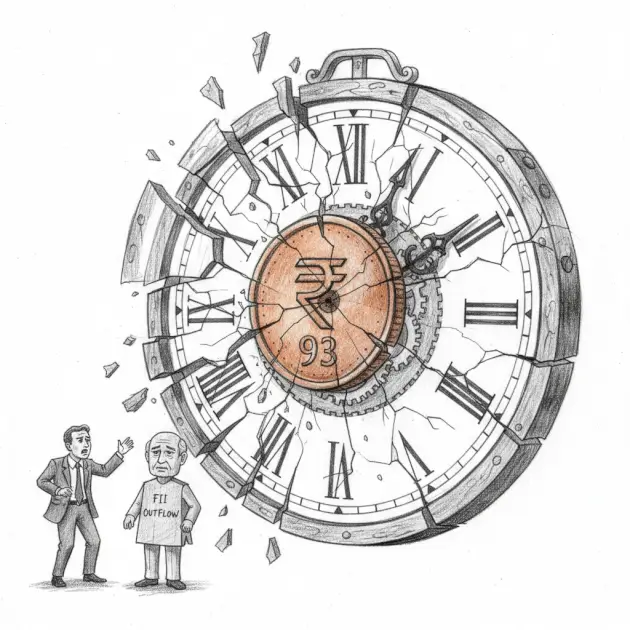
Everyone is talking about the chairman. That’s exactly the problem.
The dominant narrative around HDFC Bank’s current distress — the one driving headlines, structuring analyst calls, filling out the bearish short interest that has climbed to record levels — centers on the unexpected resignation of the bank’s chairman and what it means for leadership continuity during a still-incomplete merger integration. It’s a real concern. It is not the real concern. The Rupee just crossed ₹93 per US dollar as of March 20, 2026, a level that would have looked like a tail-risk fever dream eighteen months ago. That number is the story. The chairman is the cover.
Start with the mechanics. HDFC Bank’s stock has touched a 52-week low of ₹770 and was trading around ₹781 in Thursday’s session — while the NIFTY 50 recovered to 23,247 and the BSE Sensex clawed back to 74,929, both staging partial rebounds from their previous closes of 23,002 and 74,207. The divergence is stark. PSU banking names — SBI, Canara Bank, Bank of Baroda, PNB — rallied as much as 5% on the day. HDFC Bank went nowhere. Leadership uncertainty doesn’t selectively punish private large-cap banks while state-owned names fly. The market is telling you something about FII positioning, and most people aren’t listening.
Currency thresholds aren’t just psychological. At ₹85, ₹90, ₹93 — each successive breach triggers a mechanical re-evaluation by dollar-denominated foreign institutional investors holding Indian equity. The math is brutal. An FII sitting on HDFC Bank stock bought at earlier levels has already absorbed a meaningful currency loss layered on top of any equity mark-to-market. Bloomberg’s coverage has been explicit about the global transmission: the US-Iran war shock, now entering its second week with oil briefly at $100 per barrel, is jolting emerging market currencies broadly, and central banks from the Fed to the Bank of England are being forced into holding patterns rather than cutting. For India specifically, that means higher oil import costs widening the current account deficit while global risk appetite deteriorates and the dollar strengthens. The Rupee doesn’t have a good exit from this in the near term.
Honestly, the mutual fund overhang makes this worse in ways that are still not fully reflected in market commentary. Several major Indian equity funds carry approximately 20% exposure to HDFC Bank — an extreme concentration in a single name. As NAVs compress from continued stock weakness, retail redemption pressure builds. Past a certain threshold, fund managers become forced sellers, not discretionary ones. It’s a reflexive loop, and it has historically been difficult to interrupt once it starts. The chairman narrative contributed to the initial selloff. The MF redemption loop, if it accelerates, would drive a second leg that has nothing to do with governance at all.
The broader index recovery today actually makes HDFC Bank’s underperformance more alarming. Not less. When your stock can’t rally even as PSU peers gain 5% in the same session, that’s a signal about what investors are specifically avoiding — not just a general risk-off mood. The stock is being treated as a category unto itself: exposed to currency risk, exposed to institutional outflow, exposed to governance uncertainty, and exposed to a merger overhang from the HDFC Ltd. integration that hasn’t fully digested. Four pressure vectors simultaneously. That’s not cyclical.
The Rupee’s breach of ₹93 is not a blip. It’s the output of a regime shift: a US-Iran conflict that has repriced oil and risk assets globally, combined with an Indian economy carrying significant petroleum import dependency and a central bank constrained in its ability to aggressively defend the currency without damaging growth. This resets FII risk tolerances toward Indian equities for a sustained period — months, not weeks. The NIFTY 50 is already trading 12% below its 52-week high of 26,373; the Sensex is roughly 13% off its peak of 86,159. That’s a sustained drawdown.
Here’s the thing: the chairman resignation angle is now saturated. Short interest at record levels typically reflects an overshoot in fear — but the fear on the governance front is actually obscuring a more persistent risk that hasn’t been fully shorted yet. The FII outflow acceleration triggered by the currency move trades on a different clock. It doesn’t resolve with a new chairman appointment. It resolves when the Rupee stabilizes below ₹85 again, and there’s no clear catalyst for that right now. JPMorgan, per CNBC reporting as of March 19, has already cut its S&P 500 year-end forecast to 7,200 from 7,500 citing rising recession risk from the oil shock — the global growth backdrop against which HDFC Bank is trying to navigate is itself deteriorating.
The single most vulnerable assumption in this entire bearish thesis, though, is that the oil shock persists. If the US-Iran conflict de-escalates rapidly, oil drops back toward $70–80, the dollar softens, the Rupee retraces toward ₹84–86, and FII selling pressure in Indian equities dissipates. At that point, HDFC Bank’s 52-week low looks like an extraordinary entry point for a fundamentally sound institution navigating a temporary exogenous shock. That scenario is genuinely possible. It is not the base case today — but geopolitical situations have a way of shifting faster than anyone’s macro model can adjust, and the market’s short positioning could unwind violently in the other direction.
The FII net equity flow data for the coming four to six weeks will be the variable worth watching most closely — not earnings guidance, not the board composition announcement, not derivative positioning. Note that some of this flow data may lag the equity price action by days or even weeks, which makes real-time interpretation tricky. FII flows transmit into price with a delay. That delay is the opportunity window, in whichever direction it resolves.
There’s something telling in how India’s PSU banking stocks managed to rally while HDFC Bank didn’t. The market, in its clumsy way, is trying to distinguish between currency-exposed names and currency-insulated ones. State-owned banks carry implicit sovereign backstop assumptions in an FII risk-off scenario. Private large-caps like HDFC Bank carry no such cushion. The stock isn’t just pricing in governance risk or merger complexity — it’s pricing in the possibility that it becomes the designated exit vehicle for foreign capital leaving Indian equities in a hurry. A new chairman can’t solve that.
The market is very good at pricing what’s visible. Consistently bad at pricing what transmits with a two-month lag. And if the lag works in HDFC Bank’s favor — if flows stabilize before the next earnings cycle — investors who bought into the panic could end up looking very smart.
A war in the Middle East makes your neighbor’s retirement savings in Mumbai worth less, and everybody just shrugs and calls it “market forces” — the invisible hand’s got a pretty heavy fist.