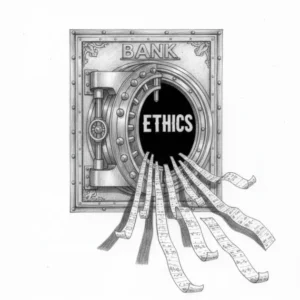
Eight percent. That’s how far HDFC Bank shares fell in a single session on March 19, 2026, touching a fresh 52-week low after part-time Chairman Atanu Chakraborty resigned and handed the market something far more dangerous than a bad earnings print: a question it cannot easily answer.
The question isn’t whether HDFC Bank is solvent. It isn’t about loan books or capital ratios or net interest margins. The question — and this is the one that tends to metastasize — is what exactly did the outgoing chairman see that made him use the phrase “ethical misalignment” in a regulatory filing? That language doesn’t land softly.
It reverberates.
The broader market didn’t wait around to find out. The BSE Sensex fell from a previous close of 76,704 to an intraday low of 74,685 on the day, a swing of more than 2,000 points before settling at 74,990 — a decline of roughly 2.2% in a single session. The NIFTY 50 fell 2.3%, sliding from 23,777 to 23,234. These are not rounding errors. Investors shed approximately ₹9 lakh crore in market capitalization across the session as of March 19, a number that reflects something broader than one lender’s boardroom drama.
Here’s the thing: HDFC Bank is not a peripheral institution. It is arguably the most closely watched private-sector bank in India, held in nearly every major domestic and foreign institutional portfolio. When its chairman resigns publicly and cites ethics, the shockwave doesn’t stay contained.
HDFC Bank’s management moved to contain the damage almost immediately, issuing assurances that there was “no power struggle” within the institution. Keki Mistry, a figure long associated with the HDFC ecosystem, was reported to be awaiting clarity on what the leadership transition would actually look like. The denial and the waiting are themselves signals. Institutions that are genuinely fine tend not to need to announce it quite so quickly.
The real damage here isn’t operational. Worth sitting with that before any recovery narrative takes hold. There is no reported deterioration in asset quality, no guidance cut, no capital adequacy concern driving the selloff. What markets repriced — sharply, immediately, and with some ruthlessness — was an uncertainty premium around governance. Governance premiums, once introduced, tend to linger longer than earnings revisions do.
Motilal Oswal held its ground. The brokerage maintained HDFC Bank on its top picks list alongside SBI as of this session, a stance suggesting at least part of the institutional community views the selloff as decoupled from the bank’s underlying earnings trajectory. Honestly, that view may well prove correct over a twelve-month horizon. But that’s cold comfort on a day when the stock is printing 52-week lows and the broader index is down 2.3%.
The 52-week low breach matters beyond the symbolic. The NIFTY 50 as of March 19 is sitting approximately 12% below its 52-week high of 26,373, and the Sensex is roughly 13% off its peak of 86,159 — though those peaks were set months earlier, so some of that gap had already been building. Indian large-cap equities were under meaningful pressure before Chakraborty filed his resignation, which means the event didn’t create a vulnerable market so much as it found one. That distinction matters.
The rupee adds its own quiet pressure. As of the latest available data, the INR/USD rate sits at approximately 92.94 — a level reflecting sustained currency softness that compounds the cost environment for import-sensitive sectors. Not the HDFC story directly, but it’s the water the fish are swimming in.
Wait — the succession dynamic deserves more attention than it’s getting. Chakraborty was a part-time chairman, which is itself a structurally unusual arrangement for an institution of this size and systemic importance. His departure, and the apparent ambiguity around what follows, raises a legitimate question about whether HDFC Bank’s governance architecture was ever quite as robust as its balance sheet suggested. The bank’s management may be right that there’s no power struggle. But the absence of a clear successor narrative, combined with the specific language of the resignation, leaves a vacuum that reassurances alone cannot fill.
What the bank needs now isn’t another statement. It needs a credible name, a clear timeline, and — if there is any substance behind the “ethical misalignment” characterization — a transparent account of what that actually meant. Markets can handle bad news. Ambiguity dressed up as resolution? Much harder.
Some seasoned India watchers will argue this is noise — that HDFC Bank’s franchise value, its deposit base, and its earnings power make this a textbook buying opportunity once the dust settles. They might not be wrong. India’s banking sector has navigated worse. “Worse” that was visible and quantifiable, though, is an easier problem than a chairman walking out the door citing ethics and leaving everyone to guess at the rest.
The selloff looks overdone relative to what’s actually known. If succession clarity arrives quickly — a real name, not a placeholder — and if the “ethical misalignment” language turns out to reflect a personal disagreement rather than something structural, this stock has room to snap back hard. HDFC Bank’s franchise hasn’t changed in a day, even if the market’s confidence has. That gap is where opportunity lives.
Funny thing is, the entire financial system can hum along just fine until someone drops the E-word — and then every portfolio manager in Mumbai suddenly discovers a conscience they forgot they had.