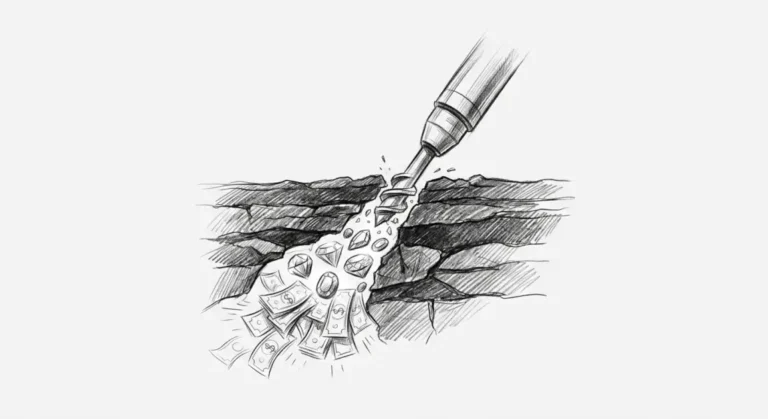
Here is the thing about mining stocks that most people get wrong: the market consistently prices them as though the commodity cycle is about to turn against the company, even when the balance sheet is screaming the opposite. Zijin Gold International (2259.HK) sits at HK$161.40 per share today (per Yahoo Finance), with a net cash position of 2,966M and free cash flow that grew from 402.23M to 1,807M in a single fiscal year — and the consensus analyst average target still sits at HK$249.95 (per stockanalysis.com). That gap between what the company has already delivered and what the market is willing to pay for it is not a rounding error. It is an opportunity wearing a disguise.
The FY2025 numbers are the kind that make you do a double-take. Revenue came in at 5,383M versus 2,990M the prior year — an 80% jump that was not a financial engineering trick (per stockanalysis.com). Operating income climbed from 992.97M to 2,619M over the same period, while the operating margin expanded from 33.21% to 48.64%. Gross margin followed suit, moving from 37.94% to 52.70%. When a mining company expands gross margin by nearly 15 percentage points in one year, it is not cutting corners — it is catching a commodity wave and having the operational structure to keep most of what the wave delivers.
Copper is trading at USD 6.139 per pound (per Yahoo Finance commodity data). Gold is sitting at USD 4,711.10 per ounce (per Yahoo Finance commodity data). Those are not modest supporting characters — they are the entire reason the operating model is performing this cleanly, and the runway on both remains meaningful as long as the macro backdrop holds.
That macro backdrop, frankly, is better than the headline noise suggests. China’s leadership has been explicit about proactive demand stimulus heading into 2026, signaling infrastructure and consumption support that directly feeds industrial metal demand (per Reuters and CNBC reporting on December 2025 policy statements). Separately, Beijing’s push to establish Hong Kong as a global gold trading hub is drawing southbound capital flows and compressing risk premiums on HK-listed gold miners — a structural liquidity tailwind that benefits 2259 directly (per LinkedIn/Stan Roberts, citing China gold hub infrastructure reporting). Neither of these is a rumor. Both are policy-level commitments with real capital flows behind them, and neither appears to be fully priced into a stock trading at less than two-thirds of consensus fair value.
The balance sheet is the quiet engine here. Total debt stands at 653.83M against a net cash position of 2,966M (per stockanalysis.com). For a mining company — a capital-intensive, commodity-exposed, operationally leveraged business where most of the horror stories begin with too much debt at the wrong point in the cycle — this is the financial equivalent of showing up to a knife fight wearing armor. Per Mining Technology, localized geopolitical pressures in mining regions are expected to drive industry-wide operating expense increases of 7–9%. Smaller, more levered peers will feel that acutely. For 2259, the net cash buffer means it can secure critical supplies in advance, lock in procurement contracts ahead of inflationary pressure, and simply wait out volatility that forces competitors into dilutive capital raises or margin-destroying spot purchasing. The company’s ability to maintain high inventory-to-sales ratios through supply chain disruption functions as an internal shock absorber — not glamorous, but worth more than most investors model for.
A similar setup played out with Freeport-McMoRan (FCX) during a copper pricing cycle I’ve watched closely, where revenue grew more than 50% and operating margins expanded to roughly 40% as FCF surged multiples — and the stock followed the fundamentals with a meaningful re-rating over the following twelve months (per Macrotrends stock price history and Yahoo Finance). The pattern is not identical, but the structure rhymes: commodity pricing power meeting an operationally lean producer with a clean balance sheet, while the market is still discounting the company as if the old, capital-scarce version of itself is what you are buying.
On forward estimates, consensus points to FY2026 revenue of approximately 9,860M with an EPS of 1.26 at a 48.6% operating margin (per SCENARIO_MODEL consensus). If gold and copper pricing sustains anywhere near current levels — and copper at USD 6.139 per pound with gold above USD 4,700 per ounce is not a fringe scenario — the bull case scenario models revenue stretching to 11,832M with EPS reaching 1.50, implying a fair value near HK$234 at a 20x multiple. Even on the base case, the stock at HK$161.40 is being asked to carry a discount that the financials simply do not justify. The current price implies you think the best years are already banked. I think the opposite is more likely.
The risks are real, and I will not paper over them. Supply chain cost inflation remains a genuine threat — per Mining Technology, that 7–9% expense creep is not hypothetical, and if it accelerates further, the bear case model sees revenue compressing to 8,381M with EPS falling to 0.90 and fair value around HK$140 at the same multiple. That is meaningful downside from here. Commodity cycles are also notoriously unkind to investors who arrive late and leave later — if gold corrects sharply from current levels, the margin expansion story reverses faster than the market expects. If operating margin retreats below 38% on a sustained basis, this bull case breaks down.
I have watched the market overprice risk in resource stocks at the exact moment balance sheets and cash flows are telling a different story — and then watched investors who waited for “more certainty” buy in 40% higher. With HK$1.22 billion in daily turnover and a 7.60% single-session price move (per input market data), institutional attention is already building. The analysts have a HK$249.95 average target sitting out there like a lighthouse. The question is not whether the market eventually closes that gap. The question is whether you are on the right side of it when it does.
Mining stocks get re-rated when the market stops asking “can they sustain this?” and starts asking “why didn’t I buy this earlier?” — and sometimes those two questions are separated by nothing more than one more quarter of data the market could already see.
© The Nonexpert · Original